McIntosh MC2105
The icon to hunt for 08 — the blue-meter amp that gave American hi-fi its face
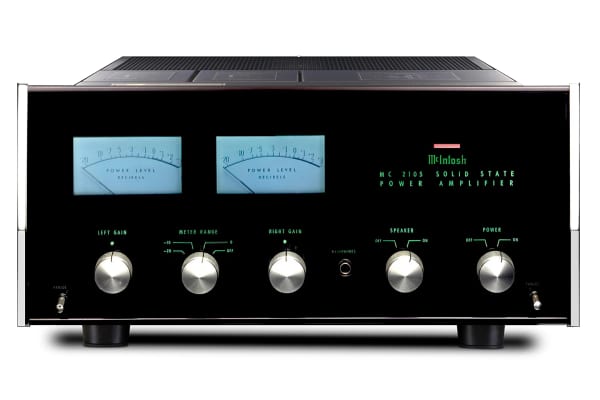
If one component says "hi-fi" the moment you look at it, this is the one. Two blue meters swinging behind black glass, the green logo glowing, thirty kilos of American iron: the MC2105 isn't just an amplifier, it's the face high fidelity wore for half a century. Launched in 1967, it's the solid-state power amp that made those blue meters the very symbol of the brand — and of a way of hearing sound. As with the NAD, the Thorens, the Quad and the Naim, I write as a buyer, not a technician, and the general method for judging anything used lives in the restoration hub. What follows is what concerns this amp in particular: why it became an icon, what makes it a keep-for-life piece, and what you need to know — restoration and glass first — before dealing on a used one.
The myth: the blue meters and the glass
In 1967 McIntosh did something rare: it took its laboratory elegance — the black glass panel, the illuminated screening, the exposed instrumentation — and put it on a transistor amp. The blue meters were born: two large power meters that dance to the music behind the glass, and with them the most recognisable face in all of high fidelity. No hi-fi brand on earth is tied to a single aesthetic detail the way McIntosh is tied to those meters.
But the MC2105 isn't only good to look at. In the middle of the transistor revolution, it brought McIntosh power — 105 watts per channel — inside a look that has never dated. It's the piece musicians asked for by name: legend has it George Harrison, at New York's Plaza in 1976, had a McIntosh rack delivered to his suite at two in the morning. Fifty years on, those blue meters are identical. Few things in consumer electronics can say the same.
Why it is the icon: the autoformer and the build
Beneath the looks is the engineering that makes the MC2105 a keep-for-life piece: the autoformer. McIntosh has always fitted an output transformer even to its solid-state amps — a contrarian choice, since transistors don't, in theory, need one. The result is that the MC2105 delivers full power equally into 4, 8 or 16 ohms, and is stable into any loudspeaker, however awkward. Where other amps of the era struggled or failed, the McIntosh stayed unmoved.
The rest is tank-grade build: thirty kilos, thermal cutouts on the heat sinks, protection against short and open circuits. It's made to last, and it does: McIntosh still services its legacy pieces and supplies parts for units from the 1970s. That's the real reason the MC2105 is the icon to hunt for rather than just a handsome vintage box — it isn't a fragile period buy, it's an amp that, restored properly, plays for another fifty years. Its signature — a rich midrange, highs that never tire, a warm, authoritative bass — is what people still call "the McIntosh sound".
Restoration: what ages
This is where the medium difficulty comes from, and it's worth saying plainly: an MC2105 is nearly sixty years old, and no piece of electronics carries that without maintenance. The good news is that restoration is well-trodden, with specialists worldwide; the bad news is that an unserviced example is a project, not a ready buy.
What ages is known. The electrolytic capacitors need redoing (the recap): they're the commonest cause of dull sound or hum. The lamps behind the panel run hot and get replaced over the years, often with LEDs that cut the heat. The most insidious issue, and the one that hits value hardest, is the glass: the screening painted on the back of the panel can bubble and lift (delamination), and a ruined panel is hard and costly to remake. Another typical fault is a faint transformer hum from the internal potting tar separating — usually harmless, but worth knowing. None of this is dramatic on a well-kept piece: but it's the difference between a bargain and a trap.
What to check before buying used
Beyond the electronics, there are things you can see that decide whether a listing is worth it.
- The glass. Look here first, and it's the dearest thing to fix. Check for bubbles, lifting of the screening, haze behind the panel. Intact glass is worth a lot; ruined glass sinks the value, and restoring it costs. - Serviced or not. Ask whether it's been recapped, and by whom. An MC2105 already serviced by a specialist costs more but is ready; one "never opened in fifty years" is a restoration to budget for. The two prices are, rightly, different. - The meters and lamps. Check that both meters move and the lighting is even: dead lamps or stuck meters are signs of neglect. - It's a power amp, not an integrated. The MC2105 has no volume, no input selection, no phono stage: it's power only. To use it — above all with vinyl — you need a preamplifier (the period McIntosh C-series, with a phono input) and a source. Knowing this first avoids the commonest mistake of a first-time Mac buyer.
The MC2105 is the icon to hunt for if you want the very face of high fidelity at home: blue meters behind glass, the McIntosh sound, a build that shrugs off decades. It's a 1967 solid-state power amp that, thanks to the autoformer, drives any loudspeaker while staying unmoved, backed by a maker that still services its vintage pieces — a used buy that, restored well, plays for another lifetime. In return it asks two things. First, attention to condition: favour a serviced example, check the glass before anything else, and if you buy a project, budget the restoration. Second, remember what it is: a power amplifier, not an integrated — you need a preamp, and for vinyl its phono stage. Do those two things and you take home not just another amplifier, but the object that gave sound a face. And that face, behind the glass, doesn't age.
Why a used MC2105 and not a new amp at the same price?
Because you get two things a new unit rarely gives together: an icon that will never date, and a build made to last half a century. The autoformer makes it stable into any speaker, and McIntosh still services its legacy pieces. Restored well, it's an amp for life. The condition is that it's in order — or that you budget the restoration.
Is it hard to restore? What does it cost?
Restoration is well-trodden: many specialists do it and parts are available. The typical jobs are the recap (capacitors), the lamps (often swapped for LEDs) and, if needed, the screened glass — that last one is the dearest. A serviced example costs more but is ready; one to sort costs less but must be budgeted for. Always ask what was done, and by whom.
Can I use it on its own?
No: the MC2105 is a power amplifier, not an integrated. It has no volume control, no input selection, no phono stage. To use it you need a preamplifier — the period McIntosh C-series, which have the phono input for a turntable — and a source. It's the commonest mistake of anyone approaching their first Mac.
What speakers does it want?
Thanks to the autoformer it drives virtually any loudspeaker, 4 to 16 ohms, staying stable. 105 watts per channel is enough in the vast majority of cases. The McIntosh character — warm, rich in the midrange — is at its best on efficient, well-recorded speakers, but it isn't fussy: it was built to make everything play.