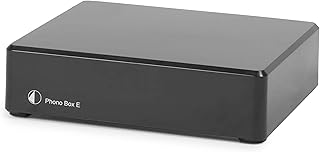
The Phono Box E is the piece no one thinks about until nothing plays. If your amplifier has no PHONO input and your turntable has no built-in preamp, this seventy-nine-euro box is the missing link between your records and any sound at all. It improves nothing: it makes playback possible. This review is about where it fits in the chain, and where its limit sits.
Context
Pro-Ject, from Austria, built an entire E-series — the entry line, in ABS cases — to bring hi-fi to the lowest prices. But to understand the Phono Box E you have to understand what a phono stage does, and it is two precise things.
A cartridge produces a very weak signal (around 5 mV) and a "bent" one: in the cutting, bass is cut and treble lifted, following the RIAA curve. Before it can enter an ordinary line input, that signal must be (1) re-equalised back to flat and (2) amplified by about 40 dB up to line level. The Phono Box E does exactly these two jobs. Nothing else.
Design & build
Under the small ABS case there is more than the price suggests: low-noise SMD circuitry (a design inspired by Dr. Sykora), internal metal shielding, and an external 18 V power supply that keeps the transformer's hum away from the audio signal. The input and output RCAs are gold-plated.
The numbers fit the role: 40 dB gain, 47 kΩ/120 pF input, an 88 dB signal-to-noise ratio, THD under 0.05%, RIAA accuracy within half a decibel. It is plastic, yes — but for a phono stage the shielding and clean power matter more than the material of the shell. And there is nothing to adjust.
What reviewers say
The sound character on this page does not come from our own listening: we report it from published reviews, with the name of the person who wrote them.
bonedo.de (Dirk Duske, July 2022, a German site) tested it in a DJ setup: against the phono input of a Pioneer DJM-S11 mixer it reports less hiss and a slightly higher output level, speaks generally of a hi-fi sound, and notes that it takes MM cartridges only.
It is the only source we cite for this model, and it says nothing about tonal character.
Vinyl performance
With the MM cartridges of the entry chain — the Ortofon 2M Red, the Nagaoka MP-110 — the Phono Box E is the natural match: their roughly 5 mV output and 47 kΩ load are exactly what it expects. It brings them to line level.
The limit is spelled out in plain letters: it is MM only. Put a low-output MC in front of it and it cannot feed it — you would hear a weak, noisy signal. For moving coils you need a different box.
Value & competition
In the entry phono field it is the cheapest honest solution: in the ranking it is the pure value pick. The question is not whether it is enough — it is — but whether you will outgrow it. If you stay with MM, the E does its job for years.
If instead you plan to move to an MC cartridge, or you want to set gain and loading, the step up is the Pro-Ject Phono Box S3 (MM/MC, adjustable) or the DC: that is where the next money goes. Buy the E for what it is — the entry enabler, not the destination.
In the vinyl chain
This is where the Phono Box E earns its place. The vinyl chain is a relay: turntable → cartridge → phono stage → amp → speakers. We have analysed the first two links piece by piece — the Rega Planar 1 and the Pro-Ject T1 among the turntables, the Ortofon 2M Red and the Nagaoka MP-110 among the cartridges. They are all MM.
The Phono Box E is the link that takes any of those cartridges and delivers them, at line level, to an amplifier that has no phono input of its own. You have the turntable, you have the cartridge: this is the box that carries them to the amp. With it, the entry chain is complete.
- Does the two invisible jobs: re-equalises the RIAA curve and amplifies 40 dB to line level
- Low-noise SMD circuit, internal shielding and external PSU; for bonedo.de it has less hiss than a Pioneer DJM-S11 mixer's phono input
- Marries the whole documented entry MM chain (2M Red, Nagaoka MP-110)
- Nothing to adjust, nothing to get wrong
- A hard MM ceiling: an MC needs a different box (Phono Box S3/DC), not an upgrade
- No adjustments: gain, loading and subsonic are all fixed
- ABS cabinet: the shielding matters more than the material, but it stays a plasticky object
Cartridges: any MM, which is what it was made for (Ortofon 2M Red, Nagaoka MP-110). Amp: any line input (AUX) or a pair of active speakers. If you will move to MC: jump straight to the Phono Box S3. Placement: keep the box near the turntable and the external PSU away from other transformers, for minimum hum.
Verdict
Buy the Phono Box E if your amp has no phono input, if you have (and will keep) an MM cartridge, and you want the cheapest way to close the gap. Do not buy it — or rather, step past it — if you are heading toward an MC or want adjustments: there the Phono Box S3 is the smarter spend.
It is not a box that impresses. It is the one that closes the gap between cartridge and amp. At seventy-nine euros, that is enough.

