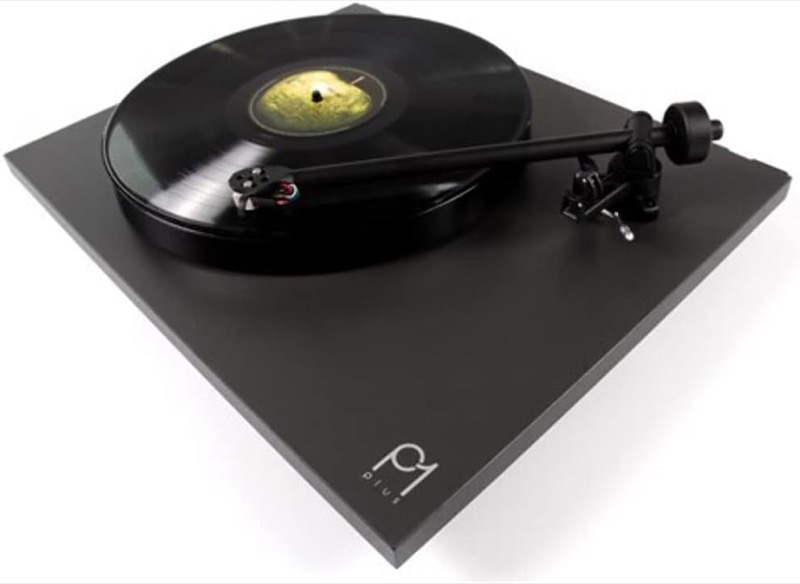
Some turntables do many things. The Rega Planar 1 does one thing, and does it properly. No electronic speed change, no built-in phono stage, no dials to turn — just a serious tonearm, a cartridge already fitted, and a way of playing records that, at this price, wins most arguments. The question this review answers is plain: what does the P1 give you, and what does it ask in return.
Context
Rega has built turntables in Essex since 1973, on a philosophy that fits in three words: less mass, more music. Low mass, high rigidity, no frills. The Planar 1 is the base of the pyramid — P2, P3, P6, P8 and P10 sit above it — and the way into Rega.
It competes with the Pro-Ject Debut, the Pro-Ject T1 and the Audio-Technica LP120, but by subtraction where they add. Where rivals bolt on USB, a phono stage and electronic speed, Rega strips them out and spends the money where you hear it — the arm and the platter.
Design & build
The heart of the P1 is the RB110 tonearm, hand-assembled, with low-friction bearings and a geometry cut for Rega cartridges. The platter is 23 mm phenolic resin, the motor a low-noise 24V unit, and the Rega Carbon moving-magnet cartridge arrives fitted and aligned at the factory: out of the box and playing.
Speed change is manual — you move the belt on the pulley to go from 33 to 45. There is no bias or VTA adjustment; it is a deliberate plug-and-play. Assembly takes two minutes. Nothing about the object feels built down to a price.
What reviewers say
The sound character on this page does not come from our own listening: we report it from published reviews, with the name of the person who wrote them.
TechRadar (Simon Lucas, November 2022, on the 2021 version described here) hears a unified, coherent presentation, with rhythm and timing that feel natural, plenty of fine detail and good dynamic range. The bass is full and well articulated, though pricier decks make it quicker. The one reservation: with recordings that are already warm and lush, the P1 indulges them a little too much.
What Hi-Fi? (2016 review, on the previous version, with the same RB110 arm and Carbon cartridge) stresses a lively sound and detail above its price class, without the warm softness of some rivals. Head to head with the Pro-Ject Primary E, it rates the Rega's timing as the more precise.
Hi-Fi Choice (Ed Selley, reprinted on the site of the UK distributor, Henley Audio), comparing it with the Pro-Ject T1 Phono SB, gives the performance edge to the Planar 1 Plus — the same deck with a built-in phono stage — and finds it more forgiving of poor pressings.
Vinyl performance
The stock Rega Carbon is well matched to the arm; step up to the Bias 2 stylus or a higher Rega cartridge and the P1 scales, because the RB110 geometry is tuned for them. With other brands the match is less natural.
Value & competition
The obvious rival is the Pro-Ject T1 Phono SB — cheaper and more complete, with electronic speed and a built-in phono stage. On sound we defer to those who compared them: Hi-Fi Choice gives the edge to the Rega and finds it more forgiving of mediocre pressings, while crediting the T1 with the better specification and the lower price.
Put simply: for convenience and everything in one box, the Pro-Ject; for a platform to grow, the Rega. Against the Audio-Technica LP120 (direct drive, USB) the P1 loses on features.
In the vinyl chain
The P1 is the source: turntable → phono → amp → speakers. Because the base version has no phono stage, the first purchase is settled: a preamp. An iFi ZEN Air Phono 2 or a Rega Fono Mini is plenty to start.
Downstream, an honest integrated (Rega io, Cambridge AXA) and a pair of standmounts (Q Acoustics 3030i) complete a balanced system in which the P1 is never the bottleneck. Mind the support: it is a light turntable, sensitive to vibration — put it on a stable shelf, away from the speakers.
- Timing and detail praised by TechRadar and What Hi-Fi?
- RB110 arm and phenolic platter usually found on pricier decks
- Rega Carbon cartridge fitted and aligned at the factory: out of the box and playing
- Base of a pyramid with a clear upgrade path (stylus, cartridge, then P2/P3)
- 33/45 speed change is manual: you move the belt by hand
- Base version has no phono stage: needs an external preamp to start
- Arm is barely adjustable and optimised for Rega cartridges: less freedom with other brands
Cartridge: stay Rega — the Bias 2 stylus or a higher Rega cartridge exploit the RB110 geometry. Phono: iFi ZEN Air Phono 2 (~£129) or Rega Fono Mini (~£90) to begin. Amp: Rega io or Cambridge AXA25 (~£250-350). Speakers: Q Acoustics 3030i or Wharfedale Diamond 12.1 (~£280-350). Support: a stable wall shelf, away from the speakers.
Verdict
The Rega Planar 1 is for the listener who puts sound and musicality ahead of convenience, and who wants a base that can grow. It is not for the buyer who wants everything integrated in the fewest boxes — the Pro-Ject T1 is there for that.
At this price you buy the arm and platter of a class above. The rest — the phono, the easy speed change — you add yourself.

