THE 3 BEST PSYCH ROCK ALBUMS ON VINYL
From the California West Coast to British acid rock, through the Texas underground. Three records that redefined the boundaries of what was possible — and that still sound like revelations on the turntable.
This guide contains affiliate links. Purchasing through these links incurs no extra cost to you.
April 2026
8 min read
There is a word rock music used with genuine honesty only once, and that word is psychedelic. Not as a marketing adjective — but as a precise description of a mental state the music sought to induce. Between 1966 and 1968, in fewer than three years, a handful of records transformed that intention into form. Not all of them survived the test of time. These three did.
The selection that follows is not a ranking of technical perfection. It is a map. Three geographical and spiritual coordinates of psychedelic rock — each irreducible to the others, each necessary.
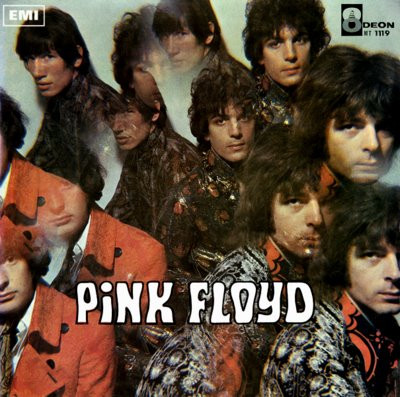
August 1967. At EMI's Abbey Road studios, while the Beatles complete overdubs on Sgt. Pepper's in Studio Two, four Cambridge boys are recording in Studio Three what will become one of the most destabilising debuts in rock history. Syd Barrett is twenty-one years old, wielding a Telecaster modified with a Zippo for slide playing, and carrying a personal vision of reality so singular that his bandmates are already struggling to follow it. The Piper at the Gates of Dawn is the document of that vision at the only moment it was still communicable.
Astronomy Domine opens with feedback that seems to arrive from another solar system before the first recognisable note appears. Interstellar Overdrive — eleven minutes of controlled improvisation that appear to have neither centre nor gravity — proves that a rock band can build tension without ever resolving it. Bike closes Side B with the lightness of a children's rhyme that carries something deeply unsettling, as if Barrett were singing from a place none of the others had yet visited.
«Syd had an ear for colours that none of us had. He built chords like rooms, and every room had a different temperature.»
— Roger Waters
Norman Smith's recording captures the instruments with a physical presence that reissues have struggled to replicate: Waters's bass is almost tactile, Wright's keyboards occupy space with an analogue density that digital still cannot simulate. It is a record that on the right turntable — and with the right pressing — does what it should: slightly alters the perception of whoever is listening.
PRESSING GUIDE
- UK mono — Columbia SX 6157 (1967) The reference mix. Black Columbia label with blue logo, laminated flipback sleeve. The mono is denser and more centred than the stereo, whose original cut suffers from crude channel separation. Clean VG+/EX copies £250–450; over £800 near-mint.
- UK stereo — Columbia SCX 6157 (1967) A weaker mix than the mono: rolled-off highs, unbalanced separation. Original £150–300. Oddly, the fifth UK issue (ca. 1978, -2/-2 matrices) sounds better than the original and costs far less, £40–80.
- Mono 180g reissue — Pink Floyd Records PFRLP38 (2016) Official remaster of the mono mix, clean and easy to find. The sensible way to hear the record as intended without collector money. £25–35.
- Caution All coloured-vinyl "Columbia" SCX 6157 reissues are unofficial. For the original, check for XAX 3419/3420 in the deadwax.
WHY IT'S #1
Because it is the only psychedelic record that cannot be explained without having been heard. Everything else in the genre derives from here — including what doesn't know it.
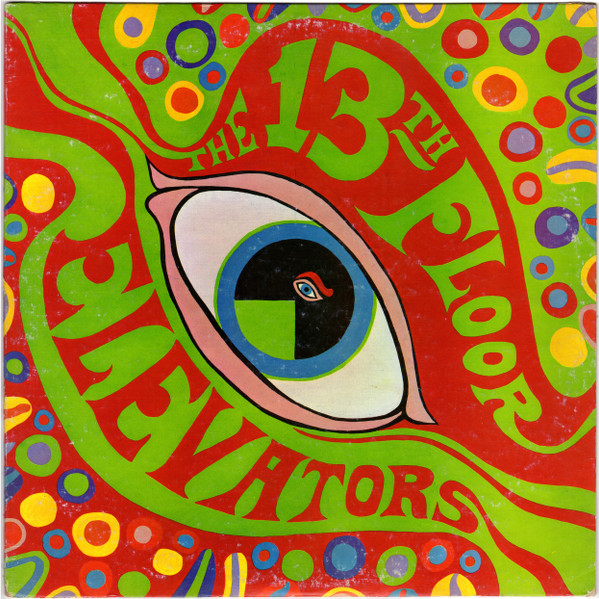
Before San Francisco had a name for what was happening, a group of Texas boys had already written the word psychedelic on a record sleeve. It was 1966, and Roky Erickson was seventeen years old. The Psychedelic Sounds is not a refined record — it is an act of brute force with the visionary clarity of those who don't yet know what they're doing is impossible.
The instrument that defines the record's sound is an electrified jug played by Tommy Hall — an amplified ceramic jug producing a hypnotic rhythmic pulse, something halfway between an Indian drone and a cosmic ticking. Above this foundation, Stacy Sutherland's guitar cuts like a blade, and Erickson's voice — hoarse, urgent, already beyond the boundary of convention — transforms lyrics of genuine interior search into something physically looming.
«We weren't trying to make a psychedelic thing. We were trying to make a true thing. The fact that it was psychedelic was the proof that it was true.»
— Roky Erickson
PRESSING GUIDE
- US mono — International Artists IA-LP-1 (1966) The grail. John Cleveland's cover art, a compact and brutal mono mix. Original masters are lost and label variants are endless. Authentic originals in good shape clear $1,500–4,500: expert territory only.
- Counterfeit warning One of the most faked psych records ever pressed. Treat any cheap "original" with suspicion — compare label, deadwax matrices and sleeve board finish before paying.
- Charly facsimile half-speed (2024, mono) Cut half-speed by Barry Grint at AIR Studios from a needledrop of an original mono (the tapes no longer exist). The most sensible route to the mono mix short of a four-figure original. £30–45.
- Approach with care The Sundazed reissue is widely called muffled; Charly's 2020 mono+stereo 2LP is solid but divides listeners. The stereo is not the mix the record was born in.
WHY IT'S #2
Because it invented the word before the concept existed. A Texas record from 1966 that still sounds like a transmission from a future that never arrived.
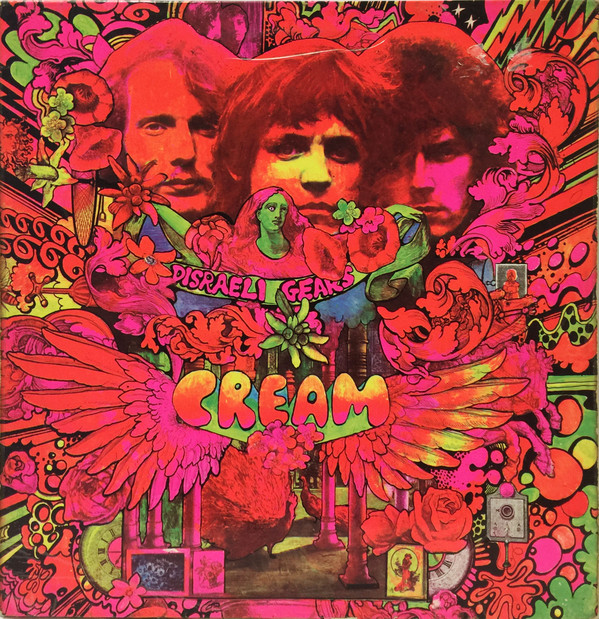
If Piper is the cosmology and the Elevators are the prophecy, Disraeli Gears is the body. Eric Clapton, Jack Bruce and Ginger Baker are not seeking to alter the perception of reality — they assault it physically. Recorded in New York at Atlantic Studios in the summer of 1967 with Tom Dowd and Felix Pappalardi at the console, the record has a sonic presence that still astonishes: each instrument occupies its own space with an almost arrogant certainty.
Strange Brew opens the record with a wah-wah guitar that Clapton uses like a brush — not as an effect, but as a colour. Sunshine of Your Love has a Jack Bruce bass riff that is probably the most copied melodic cell in British rock. Martin Sharp's cover — a psychedelic collage that still seems to come from a high-resolution hallucination — is inseparable from the music.
«With Baker on drums you didn't need a metronome. You needed an exorcist.»
— Jack Bruce
The definition of Bruce's bass — swollen, crystalline, present as a punch — is still the benchmark by which pressings of this record are judged. An original Reaction pressing in good condition has a bass that mass-market reissues simply cannot replicate.
PRESSING GUIDE
- UK mono — Reaction 593 003 (1967) The most coveted first press. Fully laminated sleeve, dark-blue labels. The mono delivers Bruce's bass with the punch every reissue chases. VG+ £120–250.
- UK stereo — Reaction 594 003 (1967) Same 2 November 1967 release, more common and affordable. A murky but full-bodied stereo mix that suits the material. £80–180.
- US — Atco SD 33-232 (1967) Early copies on yellow label, later purple/brown. The cheap, findable vintage route without UK-original money. £30–60.
- Abbey Road half-speed — ARHSLP001 (2016, mono) Miles Showell's cut divides opinion: warm to some, a touch boomy and veiled to others. Worth a look — but avoid the "Back to Black" 180g, widely judged compressed. £30–40.
WHY IT'S #3
Because it proves that psychedelia was not only a matter of mind — it was also a matter of hands. Three musicians at the peak of their physical powers using the blues as raw material for something that still has no name.
💿
THE FOURTH THAT DESERVES FIRST PLACE
Forever Changes — Love (1967)
West Coast, Arthur Lee, Elektra Records. A record in a class of its own — which is why it has its own dedicated review.
→
Three records, three geographies, three different ways of losing control with total awareness. Psychedelic rock is not a genre — it is a method. And like all methods that truly work, it has never stopped producing results.
— GROOVILLE