Dizzy Gillespie's Big 4 — my copy
My numbered copy of Big 4 on Analogue Productions: what the sleeve says, the matrices, how it sounds, what it's worth.
Analogue Productions APJ 024 · numbered limited edition · 180 gram
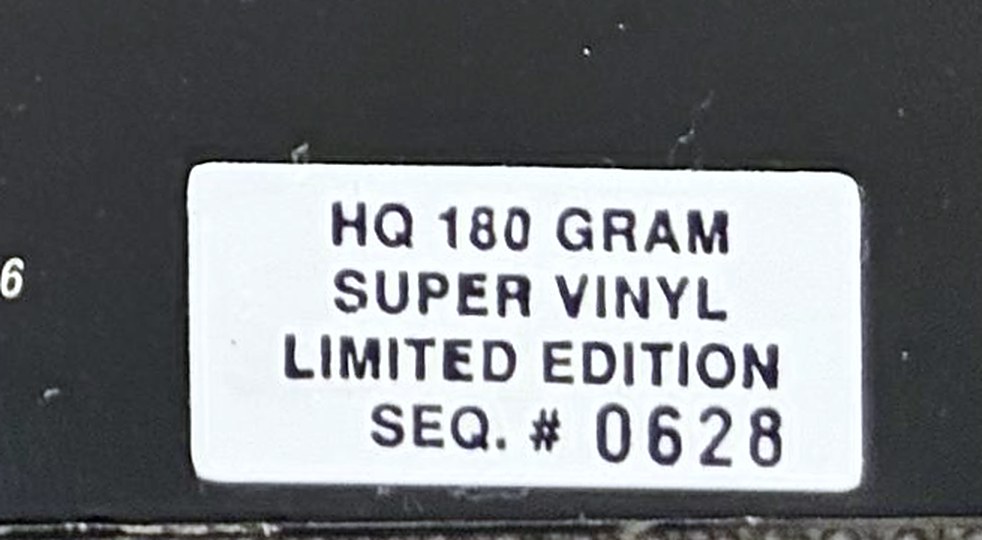
What sits on my shelf is not the 1975 Pablo record. It's a reissue made by audiophile rules — tape, tubes, a limited run — and there's a white sticker on the back that says exactly that: «HQ 180 gram Super Vinyl, Limited Edition, Seq. # 0628». 0628 is my copy's number, and it's the honest place to begin, because it tells you what this object is before we talk about the music. Analogue Productions, for anyone who hasn't crossed its path, is the Kansas audiophile label whose reissues US and UK collectors chase precisely for this kind of care.
The record
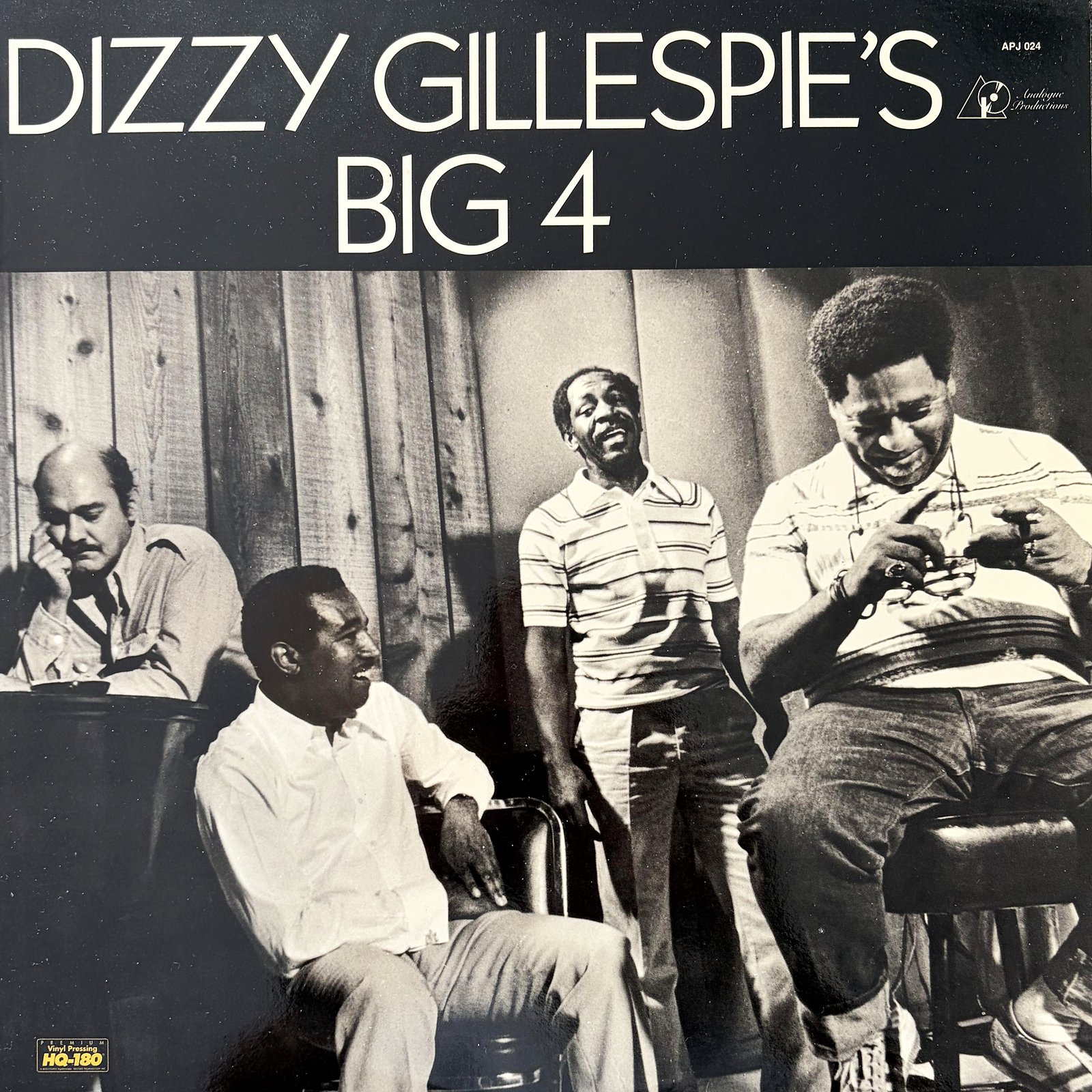
It was recorded on 19 September 1974 in Los Angeles and released by Pablo — Norman Granz's label — in 1975. Dizzy Gillespie on trumpet, Ray Brown on bass, Joe Pass on guitar, Mickey Roker on drums; produced by Granz, photograph by Phil Stern, sleeve notes signed Benny Green. No piano: four instruments, and nobody to hide behind.
It's an unusual quartet, built around the guitar in the piano's place — and the strange thing is that you don't miss the piano, because the rhythm section fills the harmonic space on its own. Ray Brown had, years earlier, been part of the rhythm section in Gillespie's big band; Pass and Roker were newer additions but bop players to the bone. Critics from AllMusic to All About Jazz tend to place it among the best small-group recordings of Gillespie's later years, and it turns up in both The Penguin Guide to Jazz Recordings and The Rolling Stone Jazz Record Guide.
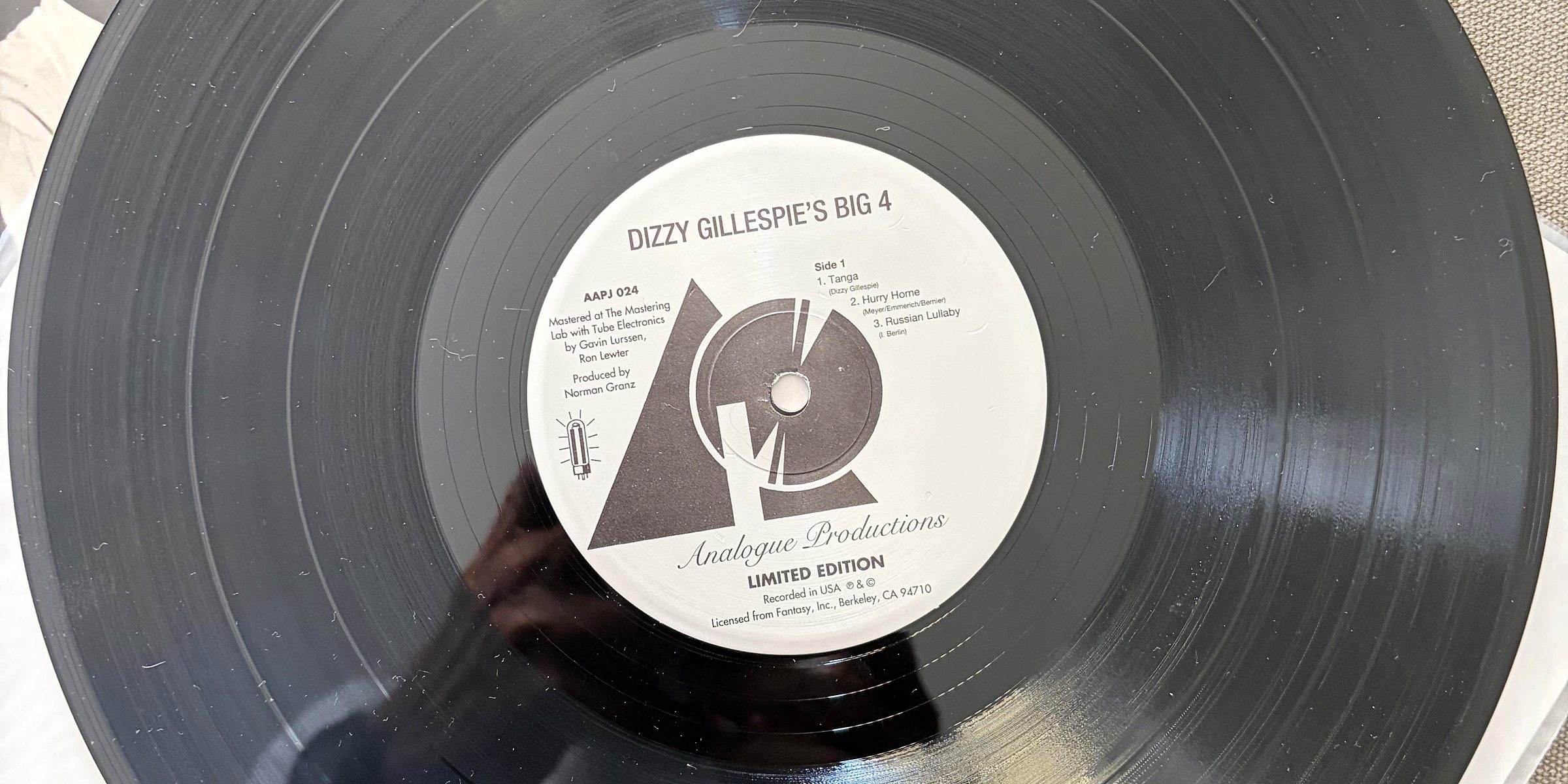
Side one is Tanga, Hurry Home, Russian Lullaby. Side two is Be Bop (Dizzy's Fingers), Birks Works, September Song, Jitterbug Waltz.
The heart of the record, for the writers who've covered it, is three pieces. Be Bop (Dizzy's Fingers) runs at a dizzying tempo — Benny Green's notes dwell on exactly that, the point where speed almost stops being a tempo and turns into something else, and the AllMusic review singles out Joe Pass's guitar there. Birks Works, the blues Gillespie named for his own middle name, is more elaborate and driven by Brown's bass. Around them sit a reading of Fats Waller's Jitterbug Waltz, a lyrical Hurry Home, a sparkling Russian Lullaby. It isn't a record out to prove anything; it's four musicians who know each other, playing at a level few reach.
What the sleeve says about the pressing
The back cover is generous with data, and it's worth reading all of it. The source tape is quarter-inch at 15 ips, with no noise reduction. The mastering is by The Mastering Lab, «with tube electronics», signed Doug Sax, Gavin Lurssen and Ron Lewter — Sax and his room being mastering royalty on the American side. Licensed from Fantasy. There's also Analogue Productions' address in Salina, Kansas.
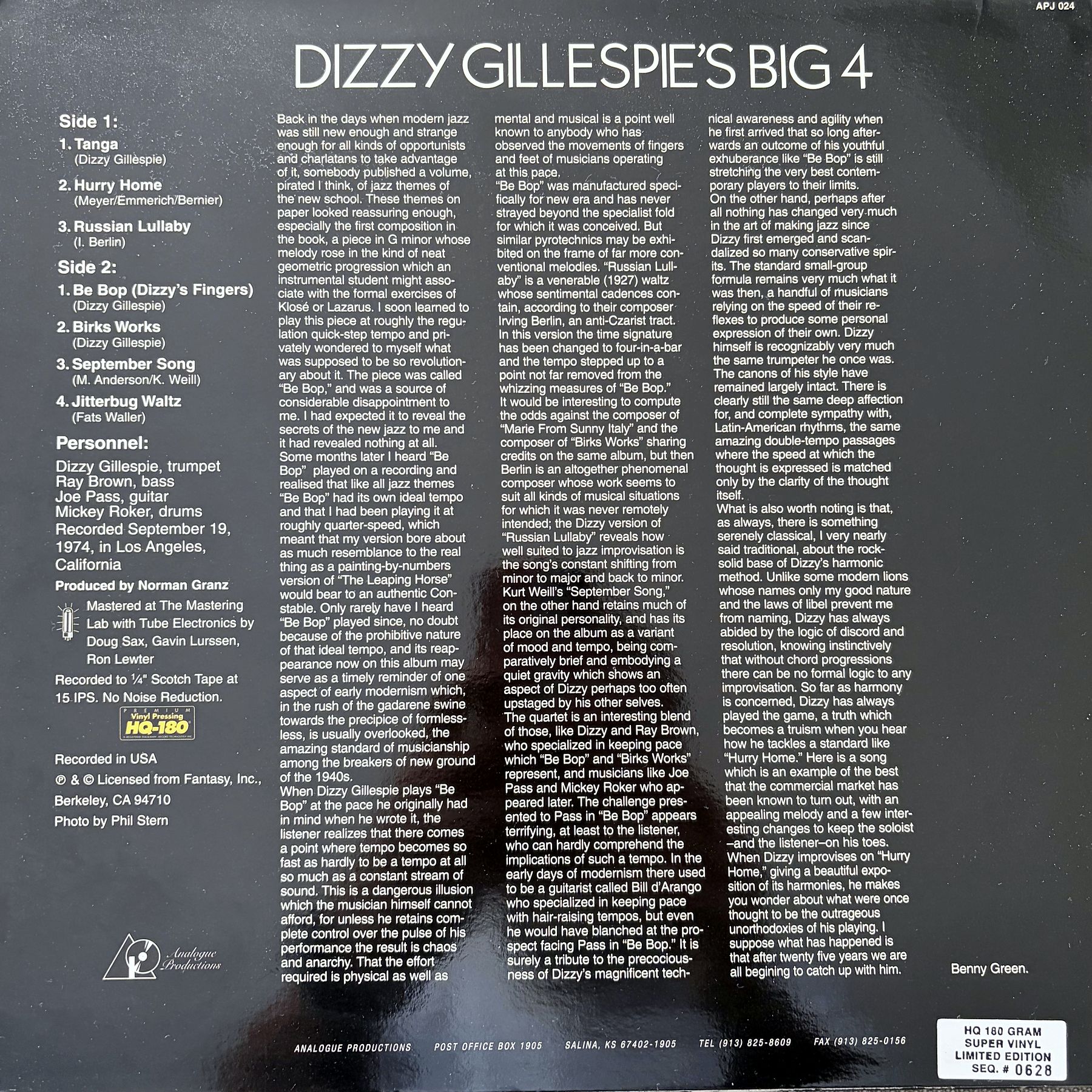
A collector's detail: the catalogue number isn't written the same way twice. The sleeve reads APJ 024, the label AAPJ 024. Discogs lists APJ 024 AAJP 024, which looks like a slip on their end.
How it sounds on my system
I play it on a Rega P7 turntable with a Rega Bias 2 cartridge, ProAc speakers, and a Klimo Merlino valve pre and power amp.
The soundstage is very well defined, the players clearly separated. Ray Brown's bass reaches me slightly dry. Joe Pass's guitar is clear and warm. Dizzy's trumpet is bright and a touch harsh. A little surface crackle, nothing more.
I don't have a second copy to compare it against, so I can't say how much of that dry bass comes from the recording, the mastering or my own chain. It's an honest limit: one copy is not a test.
The moment that stayed with me is the entrance: the way Dizzy's trumpet comes in on the opener, Tanga — smooth, coaxing — and the whole record is already there.
The pressing, line by line
In the dead wax — the smooth band between the last groove and the label — the matrices are hand-etched. On my copy I read AAPJ-024-A2 TML-M on side A and AAPJ-024-B2 TML-M on side B: the same ones Discogs lists for this release. The letters TML suggest The Mastering Lab, the studio named on the back cover — but that's my deduction, not something printed.
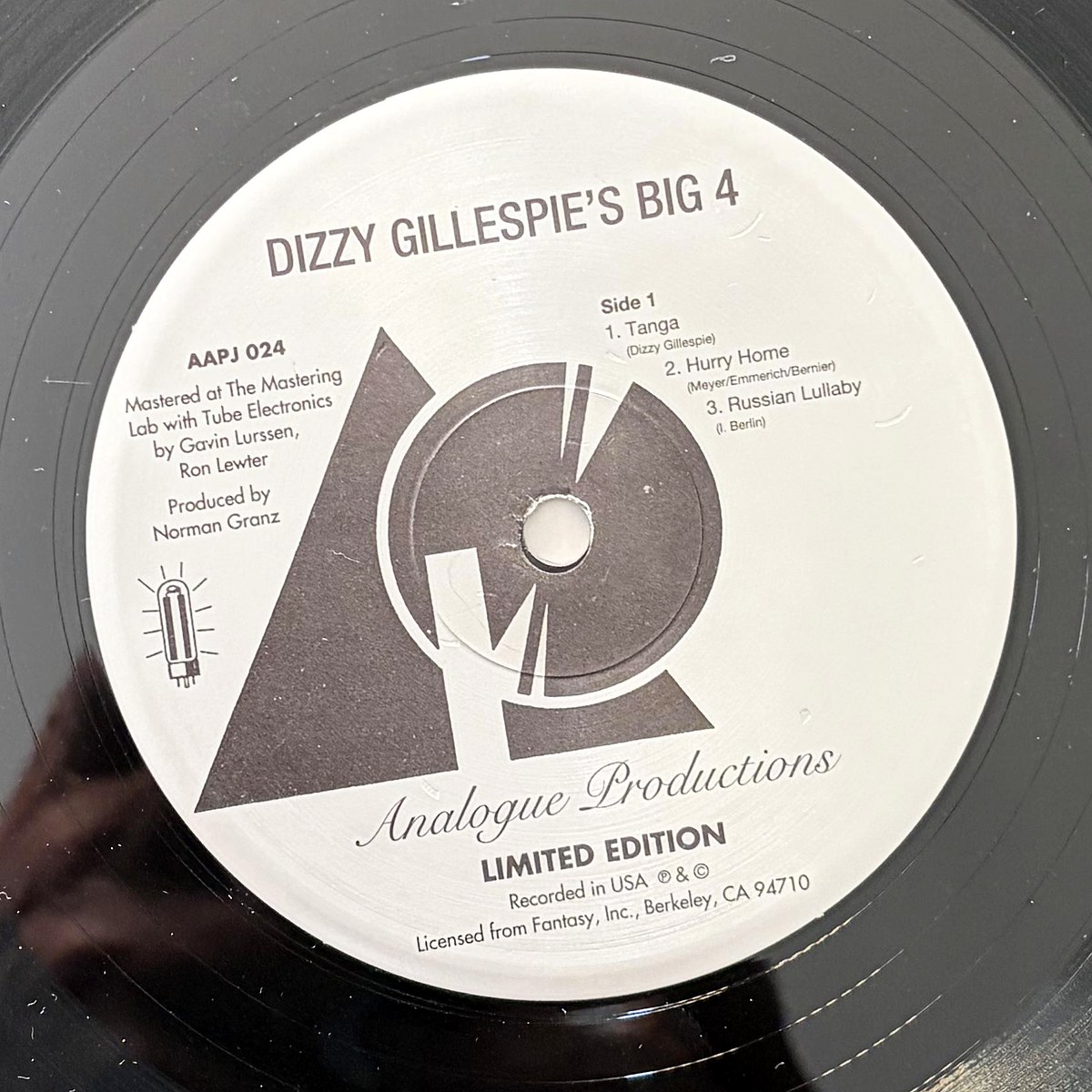
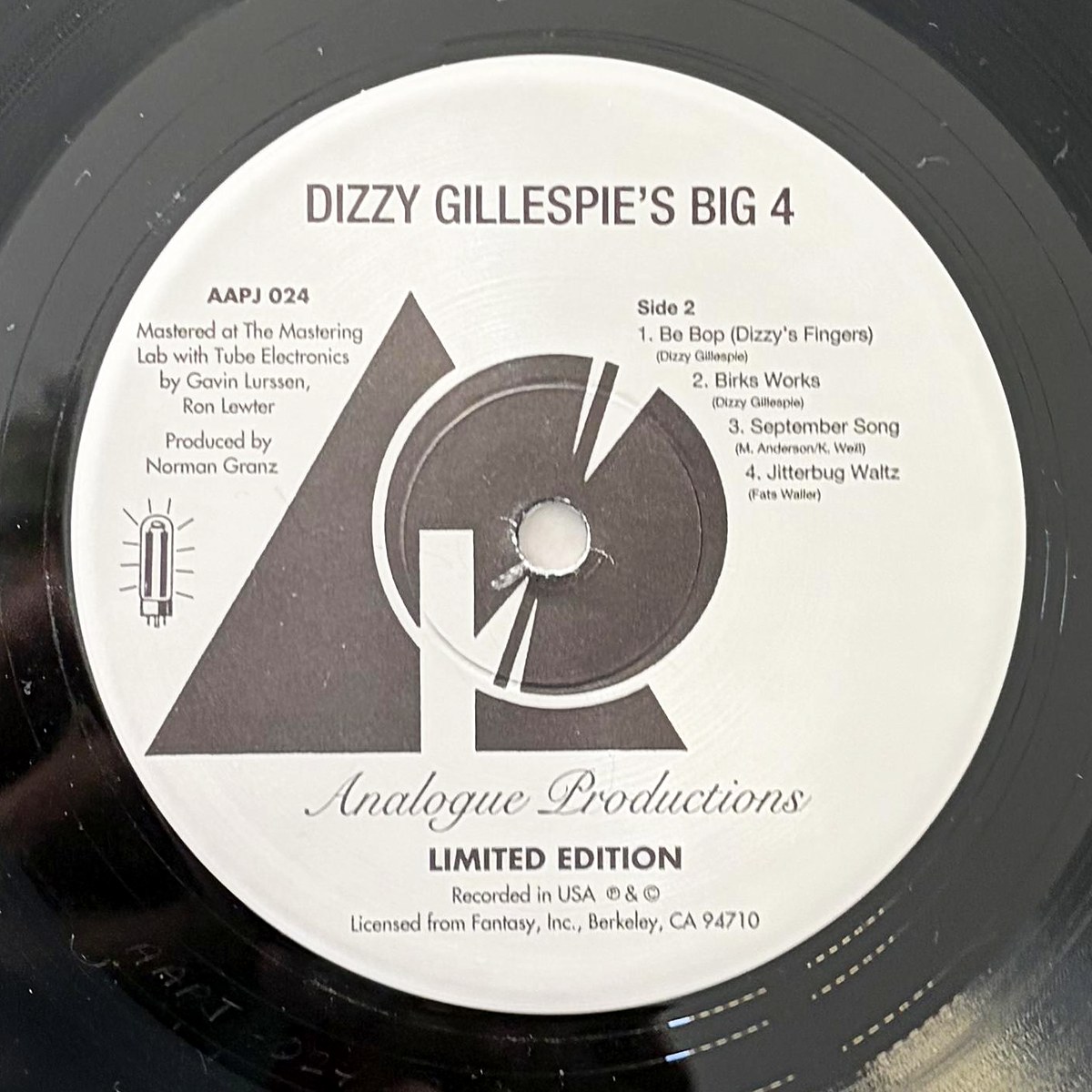
Where my copy sits. The original is the US Pablo 2310 719 of 1975. In 1990 came an Original Jazz Classics reissue (OJC-443). Then the Analogue Productions editions: one with the same APJ 024 that Discogs dates to 2006, a test pressing of the same number dated 1995, and a new numbered edition, APJ 158, from 2024. Mine is the one Discogs logs as the numbered limited edition, HQ 180G Super Vinyl. The exact year I don't know: neither the sleeve nor the Discogs page gives it. But I bought it in 2002, so the pressing is from that year or earlier — and by Discogs' dates it can't be the 2006 release.
What it's worth now
On Discogs, as of 28 September 2026, logged sales of this release run from €22.00 to €112.90, with a median of €56.58; the most recent was on 11 September 2026. The spread is wide, and Discogs doesn't separate the conditions of the copies sold — so take it as an order of magnitude, not a quote. On the US and UK collector market these Analogue Productions jazz reissues move in that same broad band.
How it reached me
I bought it in 2002 from a collector selling off his collection. It's in mint condition — my own judgement of its state, which I keep alongside the «little surface crackle» of the listening without contradiction: the copy looks and handles beautifully, and the crackle is the minimal kind a twenty-year-old record can carry.
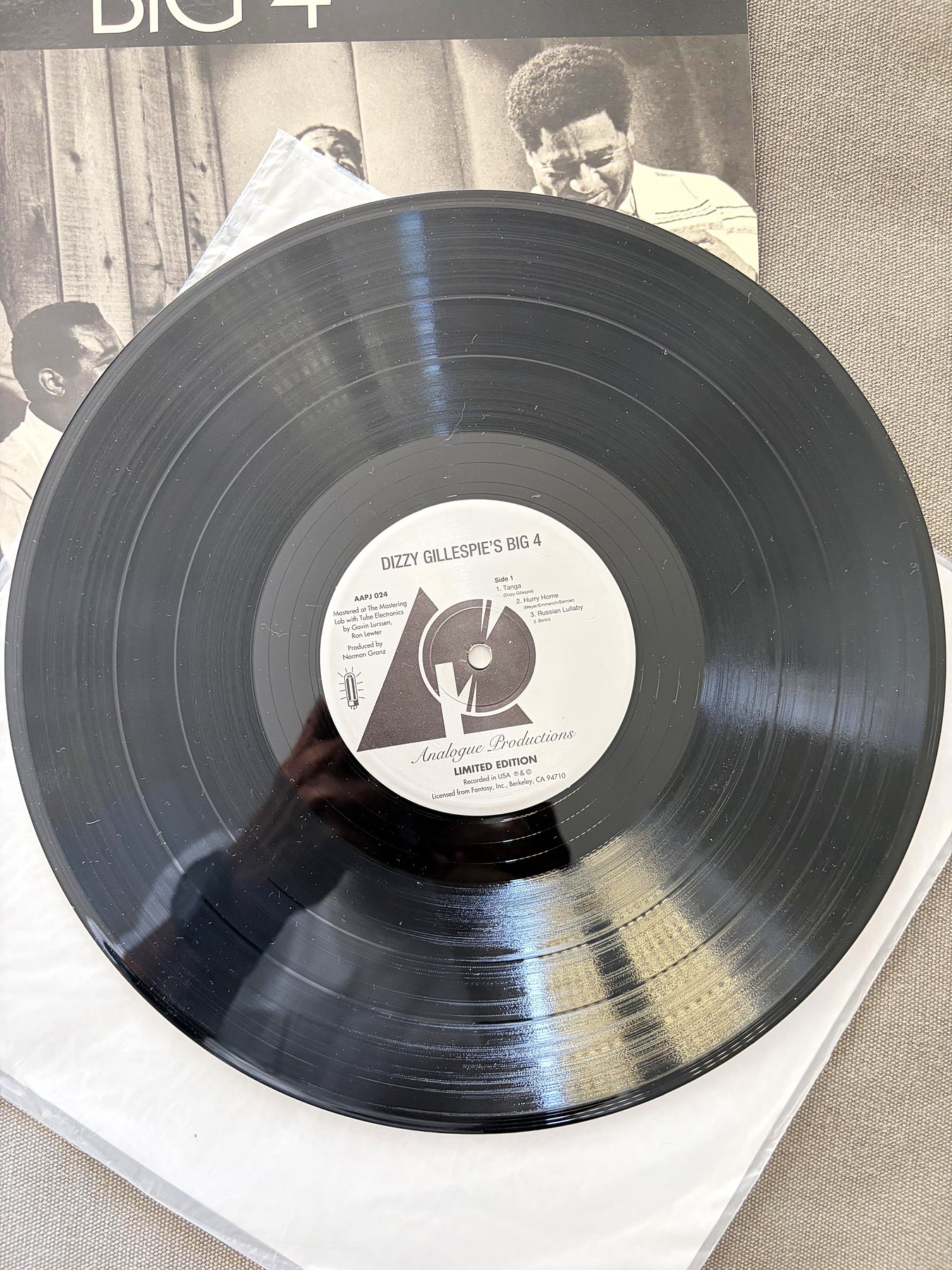
The details
Dizzy Gillespie's Big 4 (recorded 1974, Pablo 1975)
Analogue Productions, US, numbered limited edition, HQ 180G Super Vinyl
APJ 024 (sleeve) · AAPJ 024 (label)
AAPJ-024-A2 TML-M / AAPJ-024-B2 TML-M
0628
The Mastering Lab, tube electronics (Doug Sax, Gavin Lurssen, Ron Lewter) · ¼" tape at 15 ips, no noise reduction
release r8021351
€22.00 (low) · €56.58 (median) · €112.90 (high)