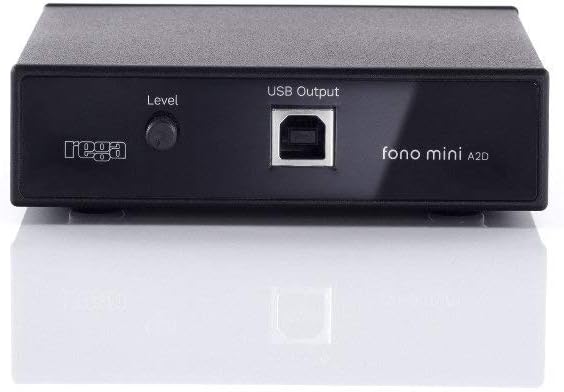
There is a question that brings many people to look for a machine like this: how do I get my records onto my computer, or my phone? The Rega Fono Mini A2D Mk2 is the simplest answer. It is not "another phono preamp": it is the phono preamp with a USB output for digitising records. You connect the turntable to it, and it to the computer, and you transfer your collection into digital files.
That is what sets it apart from the iFi and the Cambridge, which bet everything on pure sound: the Rega plays a different game. It has an excellent phono stage — a budget-class reference — but the reason you look for it, usually, is the USB port. One clarification, because Rega has similar names: this is the Fono Mini A2D Mk2, not the first-series A2D nor the Fono MM MK5 (the phono stage without USB).
Context
Rega is a long-established British maker, a specialist in turntables and phono stages, and the Fono Mini A2D is its entry model with the digitising function. The phono stage is based on the company's award-winning Fono MM — a circuit the press treats as a budget-class reference — with the addition of the analogue-to-digital converter and the USB output.
The "Mk2" is a cosmetic and usability update of the original A2D: a new gloss fascia, a relocated ground post for connecting the turntable more easily. Sonically and operationally it is identical to the previous version — an honest detail to know if you compare the two on the used market.
Design & build
It is a compact extruded-aluminium box, well built in the Rega tradition, if plain in appearance — "nothing to shout about" aesthetically, as one reviewer put it, but solid. On the back you find the RCA input and output and the ground screw; on the front, the thing that gives the machine its name: the USB output (Type B), flanked by two controls, one for level and one for balance.
Those two controls are not a cartridge gain adjustment — the A2D is set for standard MM cartridges and does not adjust in that sense — but they let you set the optimum level and balance when recording to the computer, so as to make the most of the record's dynamics. It is the practical touch that other USB phono stages often lack.
Sound analysis
Here comes the surprise: beyond the USB, the A2D sounds very good. The phono stage derived from the Fono MM has the Rega signature — musical integrity, dynamics and a sense of rhythm — and it is the reason What Hi-Fi has kept it for years as its budget phono reference. On a track with drive, a good soul cut or a rhythmic piece of jazz, it holds the timing with a push that dearer phono stages sometimes lose.
It is not a "warm" or coloured preamp: it is clean, dynamic and direct, faithful to the source. For analogue listening — connected to a line input on the amp via RCA — it is an excellent phono stage in its own right, regardless of the USB function. It is why it deserves a review at all, even outside the digitising context.
Vinyl performance
On vinyl, in normal playback, the A2D does what it should: it lifts the MM cartridge to line level with an accurate RIAA and a rhythmic, orderly sound. It is at home with the moving-magnet cartridges of entry turntables — a Rega, an Audio-Technica, an Ortofon 2M — and returns the record with life.
The declared limit is the same as the Cambridge's: it is MM only. With a moving-coil cartridge it is not compatible. But for the audience it speaks to — those with an MM-cartridge turntable who want to listen and, when needed, archive their records — it is exactly the right tool.
Value & competition
Comparing it with the iFi ZEN Air Phono 2 and the Cambridge Alva Solo would be unfair if done on their ground: those are built for pure sound and versatility. The iFi handles MM and MC and has adjustable gain; the Cambridge is the best-built object, with the balance control. On that plane, the A2D is simpler: MM only, not adjustable.
But the A2D has one thing neither of them has: the USB output for digitising vinyl. It is the only one of the three that puts your collection on the computer, and it has a budget-reference sound besides. It does not compete with the others on phono versatility: it plays a different game. If you only want to listen and one day move to an MC, the iFi suits you better; if you want to digitise your records — or want the most musical phono for little money — the A2D is the answer.
In the vinyl chain
How to digitise a record, in practice. You connect the turntable to the A2D's RCA input, and the A2D's USB output to a port on the computer (Mac or PC). On the computer you install a free audio editor — Rega itself suggests Audacity — which records the incoming signal. Start the record, press "record", and with the level and balance controls on the front you set the best recording. At the end of the side, you split the tracks and export them in the format you prefer.
It should be said honestly what to expect. The conversion is 16-bit / 44.1 kHz (up to 48 kHz): it is CD quality, not hi-res — perfect for listening on headphones, on the phone or in the car, less so for audiophile archiving, for which dedicated, far dearer converters exist. And digitising is real-time: a forty-minute album takes forty minutes, plus the time to split the tracks. It is not an audiophile converter, it is a phono stage with a practical, well-made USB — and it is precisely what most people who want their vinyl in digital need.
A note on availability outside Italy: the Fono Mini A2D is found mainly through specialist hi-fi dealers rather than the generalist channels, and in the United States it is not currently covered — the UK link points to eBay. It is how gear at this level is sold, not a fault of the product.
- The only one in the class with a USB output for digitising vinyl
- A reference phono stage (based on the Fono MM): musical and rhythmic
- Level and balance controls for optimal recordings
- Excellent price for a phono that stands on its own, USB aside
- MM only: not compatible with a moving coil
- 16-bit / 44.1 kHz conversion: CD quality, not hi-res
- Real-time and slightly laborious digitising (needs patience and Audacity)
- Plain looks and a small case, less premium than the Cambridge
Turntable: any model with an MM cartridge (Rega, Audio-Technica, Ortofon 2M). Computer: a Mac or PC with a USB port and a free audio editor (Audacity) for digitising. Amplifier: one with a line input, for analogue listening via RCA. RCA cable and USB cable not included: get your own.
Verdict
Buy the Rega Fono Mini A2D Mk2 if you want to digitise your vinyl without fuss, or if you simply want the most musical phono preamp in the budget class — because the A2D is both. The phono stage is a reference, the USB output does a job no direct rival offers, and the price is honest.
It is not for you if you plan a moving-coil cartridge (it is MM only — look at the iFi) or if you want a high-resolution archiving converter (this is CD-quality, practical, not audiophile). But for the most common intent — putting your collection on the computer while still listening to it well in analogue — it is the right tool, and one of the few that genuinely does both at once.

