NAD 3020
Twenty watts that broke the myth of amplifier power
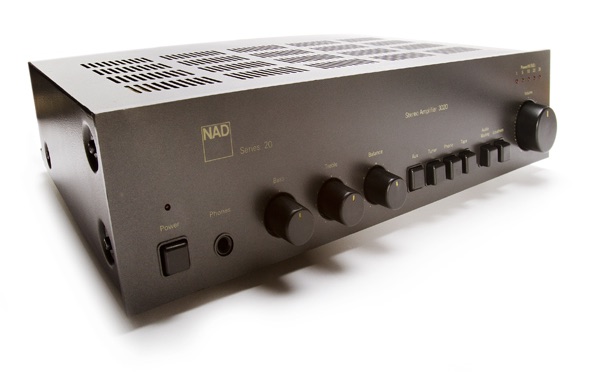
There is a particular moment when the NAD 3020 stops being a name that circulates on forums and turns into a practical question. One comes up for sale at not much more than a hundred pounds, grey unassuming fascia, five little red lamps in a row, and you find yourself wondering whether this is the bargain everyone describes or a problem you are about to carry home. Let me answer from where I can. I am not a technician, I have never recapped anything, and what follows is the reasoning of a buyer rather than a repairer. The general method — what ages in a forty-year-old component, which questions to ask, how to do the arithmetic — lives in our guide to restoring vintage hi-fi, and there is no point repeating it. This piece holds only what applies to this particular amplifier: why it matters, how to tell the versions apart, and what to check.
Why it became a classic (and it is not nostalgia)
The 3020 arrived in 1978, the year on NAD's own data sheet (some sources put its actual market arrival in 1979). Wikipedia, drawing on NAD's documentation, credits Bjørn Erik Edvardsen, who led advanced development at the company, with setting out to build an inexpensive amplifier able to drive the very best loudspeakers. The market then belonged to Japanese receivers: handsome fascias, knobs everywhere, generous power figures in the catalogue. The NAD was a grey box with a plastic front panel and twenty watts per channel on the label. On paper, a minnow.
The catch is that those twenty watts were continuous into 8 ohms, and behind them sat a power supply overbuilt for the class. With 3 dB of dynamic headroom, the amplifier could deliver 40 watts into 8 ohms, 58 into 4 ohms and 72 into 2 ohms for short bursts, according to the data sheet — doubling down, in other words, rather than folding, as speaker impedance dropped. At its American launch NAD wired up a bank of loudspeakers presenting a 1.1-ohm load and the amplifier took it without complaint, as Peter Tribeman, then head of NAD in the US, recalled to TONEAudio; in London, Wikipedia reports, it was made to drive Linn Isobariks, notoriously punishing for any power amp. A front-panel Soft Clipping circuit softened distortion when pushed.
That is what makes it a classic — not that it "sounded better", but that it proved something still worth knowing. The wattage on the catalogue page tells you very little; what matters is how an amplifier behaves in front of the real load you connect to it. That it was also one of the best-selling integrated amplifiers ever made is repeated everywhere, with figures ranging from half a million to well past a million units: numbers that have circulated for decades without an independent source. Treat them as reputation, not data.
Why it matters to a record listener
For a reader of this site the reason is single and concrete: the 3020 has a built-in MM phono stage, and it is widely held to be a good one: Chris Martens, in The Absolute Sound in 2004 (quoted by Wikipedia), found it clearer and better balanced than many dedicated phono stages of the day. Which means a turntable plugs straight into it, with no external preamp.
That is not a nostalgic footnote. A good share of today's budget amplifiers have no phono input at all, and putting one back means buying another box. And the twenty watts that look alarming on paper are, in an ordinary room with a pair of bookshelf speakers, sufficient — the same arithmetic we run in our ranking of integrated amplifiers for vinyl, where the original 3020 appears as the classic to hunt for alongside its modern descendant.
An entry-level turntable with a moving-magnet cartridge — a Rega Planar 1, a Pro-Ject T1, an Ortofon 2M Red — is exactly the kind of source that input was designed around.
The variants, and how to tell them apart
Precision matters here, because the 3020, 3020A, 3020B, 3020e and 3020i are different products and are constantly conflated. In order: the original 3020 of 1978 (the same family also produced the 7020, the receiver version); the 3020A, from the early 1980s; the 3020B, from mid-decade, alongside the 3120, essentially a 3020B with the tone controls removed; then the 3020e and 3020i, which represent a deeper revision.
The reliable way to identify one is to look at the back and the front panel, because those differences can be checked in a photograph:
- A rear shelf carrying the connections, with spring-clip speaker terminals → the early machines (3020 and 3020A). - Proper binding posts that accept bananas → the 3020B. This is also the version credited with a switchable MM/MC phono input. - Smaller selector buttons on the front and connections mounted directly on the rear panel, no shelf → the 3020e or 3020i. The 3020i is reported to have more regulated supplies and a switch intended for 4-ohm loads.
On the sound of the different versions the literature is plentiful and only half agreed: received opinion favours the early machines up to the B and regards the e and i as different animals, leaner and less full-bodied. It is worth saying plainly that this is reputation gathered from forums and memory rather than measurement. The practical conclusion is less romantic and more useful: the condition of the individual machine counts for more than the letter on the front. A serviced 3020i beats a cellar-kept first series every time.
What to check before you buy
The general questions — has it been serviced, when, by whom, are there receipts — are in the hub. Add one that belongs to the 3020 specifically: ask for a photograph of the rear panel before you travel: it identifies the version without any argument.
When you listen to one before buying, use the general checks in the hub: hum with the volume at zero, controls turned through their full travel, both channels at low volume. We do not list faults specific to the 3020 here, because the ones that circulate come from forums and owners' memories, not from a source we can cite.
Above all: try the phono input with an actual turntable, not just the line inputs. It is half the reason you are buying the thing, and it is the part almost no seller checks.
What to expect to pay
No hard figures here, because price depends on version, cosmetic condition and above all on what has been done to the machine. Check current and sold listings before you buy: these were made in great numbers and prices swing widely.
To that you must add the line that decides everything: the service, if it has not been done. The hub explains why no universal quote exists and why, on an inexpensive machine, that cost is never marginal. The honest sum: an unserviced 3020 plus a proper service can approach or exceed the price of a new entry-level integrated — and our ranking of amplifiers with a phono stage starts around three hundred euros. Find one already serviced with receipts, on the other hand, and you are buying something different: a machine that is ready, with the unpredictable part of the cost already paid by somebody else.
Is it worth it?
Yes, on three conditions. If you find one serviced and documented; if the phono stage genuinely matters to you, since it is the machine's best argument for a record listener; and if you have ordinary speakers in an ordinary room. On those terms you get a piece of hi-fi history that still does its job, with a build and a phono stage you will not easily find at the price today. And it sells on: here, fame protects value.
No, in three cases. If it is offered untested at a full price — there you are paying for the seller's risk. If it is to be your only system and no technician is within reach. And if you want real power for a large room or for insensitive modern speakers: the legend concerns behaviour into difficult loads, not an infinite reserve of watts.
One last note, for honesty's sake. The 3020's reputation is real but it is not unanimous, and buying one expecting a revelation is the surest route to disappointment. Buying it for what it is — an honest integrated with a good phono stage, which changed the way people read a spec sheet — is the right way round.
The NAD 3020 earns its reputation for a verifiable reason: twenty continuous watts that doubled down rather than folded into a difficult load, proving that catalogue wattage tells you very little. For a record listener the real argument is the built-in MM phono stage. Identify the version from the rear panel (spring clips and a shelf = early series; binding posts = B; direct connections = e or i), run the general checks in the restoration hub, and always try the phono. Buy one that has been serviced with receipts: it is the only version of this bargain that stays a bargain.
Affiliate link — no extra cost to you · How we review →
Which version of the NAD 3020 should I look for?
Received opinion favours the early machines up to the 3020B and treats the 3020e and 3020i as different animals. But that is reputation rather than measurement: in practice the condition of the individual unit and the existence of a documented service matter more than the letter on the fascia.
Are twenty watts really enough?
In an ordinary room with bookshelf speakers, yes. The 3020 was built to cope with difficult loads instead of folding, and it has around 3 dB of dynamic headroom. If you have a large room or insensitive modern speakers, you need something else.
Can I connect a turntable directly?
Yes: it has a built-in MM phono stage, and that is one of the reasons it still matters. The 3020B is credited with a switchable MM/MC input. Always test it before buying, with a real turntable: it is the part almost no seller checks.