Three albums, no stage
Three records, barely any sales, no touring. Then a car commercial turns the quietest folk singer of his era into a permanent fixture.
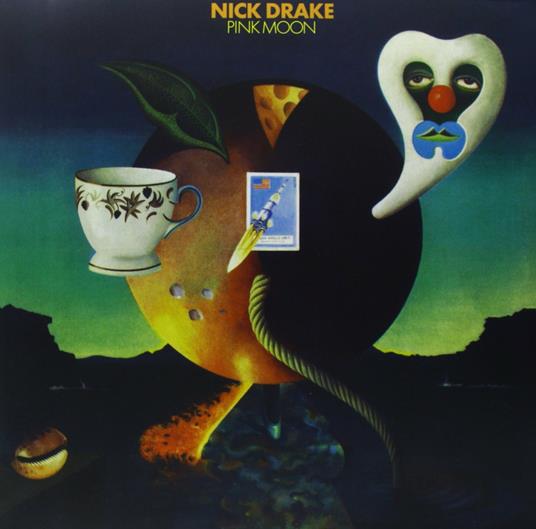
Sound Techniques, Chelsea, the small hours of 30 October 1971. Nick Drake walks in near eleven at night with no band, no arranger and no warning, and across two sessions cuts a record of voice and acoustic guitar that runs barely twenty-eight minutes. The only other person in the room is the engineer John Wood. When it is done he leaves the master tapes at Island's office without a word. The record is Pink Moon, and almost nobody notices.
Drake is born in Rangoon on 19 June 1948, the son of an English engineer posted to Burma, and raised in Warwickshire. After Marlborough and Fitzwilliam College, Cambridge — which he leaves before taking a degree — the producer Joe Boyd signs him through his company Witchseason to Chris Blackwell's Island label. Everything Drake records is made in the same place: Sound Techniques in Chelsea, with John Wood at the desk. On the first two albums the string charts come from Robert Kirby, a Cambridge friend barely into his twenties.
Drake plays in open tunings he devises himself, and his right hand has a cleanness that the people around him never forget — the bassist Danny Thompson, present on Five Leaves Left, talks about it for decades. He is a fastidious technician: for a single line of "Free Ride" he drops his bottom string to a low A purely to put the right note under the right finger. That precision does not survive a noisy room. Between 1970 and 1971 he stops performing entirely. No tour, no single, no television. The records are all that is left.
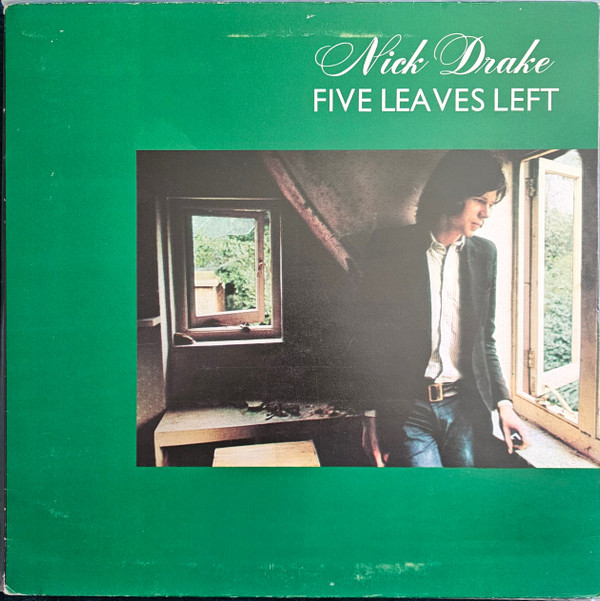
Five Leaves Left (Island ILPS 9105, 1969) is the record of Kirby's strings; "River Man," built on a 5/4 that turns on itself like an eddy, is its centre of gravity. Bryter Layter (ILPS 9134, 5 March 1971) reaches for the light. Fairport Convention players — Richard Thompson on guitar, Dave Pegg on bass, Dave Mattacks on drums — and John Cale, who adds celeste and organ to "Northern Sky," build a wider, chamber-pop sound. It is the failed attempt to give Drake an audience.
Then, on the nights of 30 and 31 October 1971, he does the opposite. He arrives at Sound Techniques around eleven, with John Wood alone, and across two sessions records Pink Moon: eleven songs, twenty-eight minutes and twenty-two seconds, voice and guitar, with one piano figure overdubbed onto the title track. He drops the masters at Island's reception unannounced and leaves. It comes out on 25 February 1972 (ILPS 9184), the only one of his albums issued in North America in his lifetime.
«Pink Moon is not a farewell note. It is a statement: the plainest possible version of what Drake could do.» — Groov-illa
Pink Moon meets a press and a public largely indifferent to it. Drake retreats to his parents' house in Tanworth-in-Arden, weighed down by a depression the medicine of the day treats with blunt instruments. On 25 November 1974 he is found dead from an overdose of his prescribed antidepressant. The inquest records a verdict of suicide, still disputed — John Wood and Cally Callomon, who now runs Drake's estate, have always held that he was proud of the record, not preparing to leave. He is twenty-six, with three albums the world has barely heard.
The rehabilitation comes slowly. In 1973 John Martyn dedicates Solid Air to him; in 1979 the Fruit Tree box set returns the whole catalogue to circulation and hands critics a body of work to reckon with. For fifteen years Drake is a name traded between musicians more than heard by listeners. Then, in 1999, a Volkswagen Golf Cabriolet commercial built on the title track of Pink Moon puts him into millions of American homes for the first time: in the months that follow, the album sells more copies in the United States than in all the years before it combined. The catalogue has not gone quiet since.
Drake had no imitators while he was alive — he was not known enough to have any. The influence came posthumously, and it ran deep. Several artists whose work defined the decade after his rediscovery have cited him as a direct reference point.
The original Island pressings — ILPS 9105, 9134, 9184, with the "pink rim" palm-tree label — are the most sought-after objects. There is a quirk every Drake collector knows: precisely because he sold so little, Island kept re-pressing from the original lacquers for years, the ones stamped A-1U and B-1U in the run-out. The upshot is that even certain 1970s repress copies sound essentially like first pressings — a rare break for anyone unwilling to pay auction money. Original pink-rim copies in Near Mint still clear several hundred euro on Discogs, and the best go beyond.
For listening rather than collecting, the modern reference comes from a specific piece of work: John Wood himself remastered the whole catalogue in an all-analogue chain at Abbey Road Studios, from the original tapes. The Island/Universal 180-gram reissues (2012–2013) come out of those sessions — quiet, with the gatefold faithfully reproduced. Buy those.
Three albums in three years, no tour to speak of, a few thousand copies sold while he lived: measured by the industry's yardstick, Nick Drake's career was an almost complete failure. It has become something else over time — the model for anyone who, after him, wanted to do little and do it exactly. The audience arrived once he was gone, and it has not left.
Nick Drake — Five Leaves Left
- Pressing
- Original Island ILPS 9105 (1969) · Recommended: Island/Universal 180g reissue (2013), all-analogue
Which pressing? Check it on Discogs ↗
Nick Drake — Bryter Layter
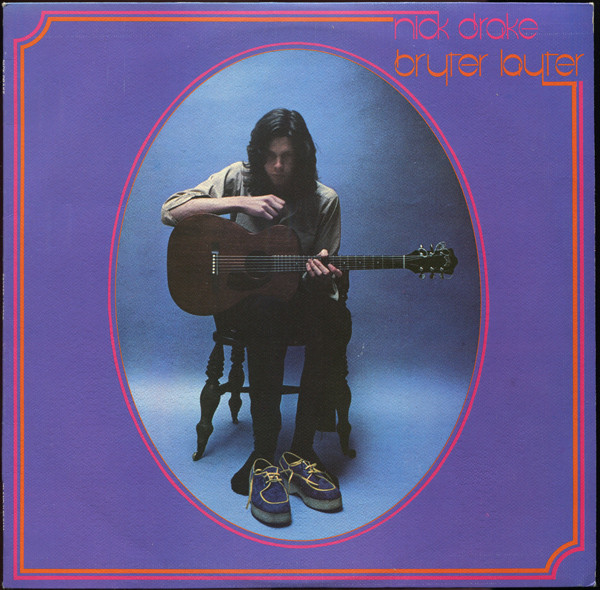
- Pressing
- Original Island ILPS 9134 (1971) · Recommended: Island/Universal 180g reissue (2013), all-analogue
Which pressing? Check it on Discogs ↗
Nick Drake — Pink Moon
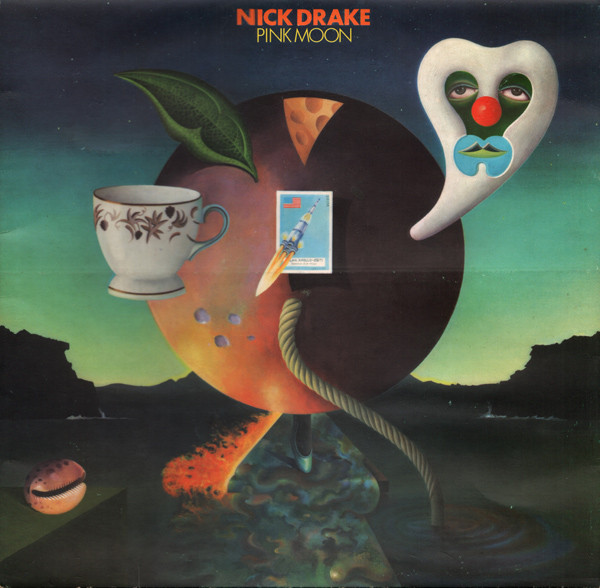
- Pressing
- Original Island ILPS 9184 (1972), pink rim label · Recommended: Island/Universal 180g reissue (2013), all-analogue
Which pressing? Check it on Discogs ↗