Understanding Krautrock: Can, Neu!, Kraftwerk
Can, Neu! and Kraftwerk: three German answers to one question. The story of krautrock, the motorik beat, and how West Germany rebuilt rock without the blues.
In the years after the war, a generation of young West Germans looks at rock and roll — at the blues underneath it, at the American and British accents it borrows — and decides it wants none of it. It has no tradition to fall back on and no wish to inherit one. What it builds instead, in studios carved out of castles and disused cinemas, is a music of repetition and forward motion that the British press will christen, half in mockery, krautrock.
The word is one the Germans never use about themselves; Faust reclaim it with a wink, opening Faust IV (1973) with a track called "Krautrock." And krautrock, for that matter, is not a single genre but a constellation of approaches: different scenes, in different cities, held together more by an attitude than by a sound. What holds Can, Neu! and Kraftwerk together is not a shared sound — they could hardly be more different — but a method: repetition in place of the chorus, the machine in place of feel, the refusal of the twelve-bar as a founding act. Three bands, three answers to a single question: what music does a country make when it wants to start again from zero?
An English word for a German thing
The generation that invents krautrock is born during or just after the war and raised in a country desperate to forget its recent past. Rather than claim a folk tradition of its own, it rejects the Anglo-American models — the blues, rock and roll, the borrowed accents — and looks for a new language, turning that refusal into freedom. Three planes are worth keeping apart, so as not to blur them: the scenes (Cologne, Düsseldorf, Munich, Berlin), the bands working within them, and the compositional method — repetition, drone, the steady pulse — that runs through them all. Behind it sit the student revolts of 1968, the high avant-garde of Karlheinz Stockhausen — under whom Can's Holger Czukay and Irmin Schmidt had studied in Cologne — and the American minimalism of Terry Riley and Steve Reich.
In Cologne, Can fuse high avant-garde and free jazz. In Düsseldorf, leaner and more industrial, Kraftwerk and Neu! take shape. In Munich a more psychedelic, mystical krautrock grows — Amon Düül II, Popol Vuh. And in West Berlin, the cosmic wing: Tangerine Dream, Ash Ra Tempel, Cluster. Same generation, same refusal, different dialects.
Can: improvisation as machine
Can form in Cologne in 1968. Holger Czukay (bass) and Irmin Schmidt (keyboards) come out of Stockhausen's classes; Jaki Liebezeit (drums) out of free jazz; Michael Karoli (guitar) is Czukay's pupil, raised on the Velvet Underground, Zappa and Hendrix. Only a voice is missing. The first belongs to Malcolm Mooney, an American heard on Monster Movie (1969), who leaves in 1970 in the middle of a breakdown. The second they find in the street: in Munich, early in 1970, Czukay and Liebezeit watch a young Japanese man busking outside a café. His name is Damo Suzuki; he is on stage with them that same night, and he stays.
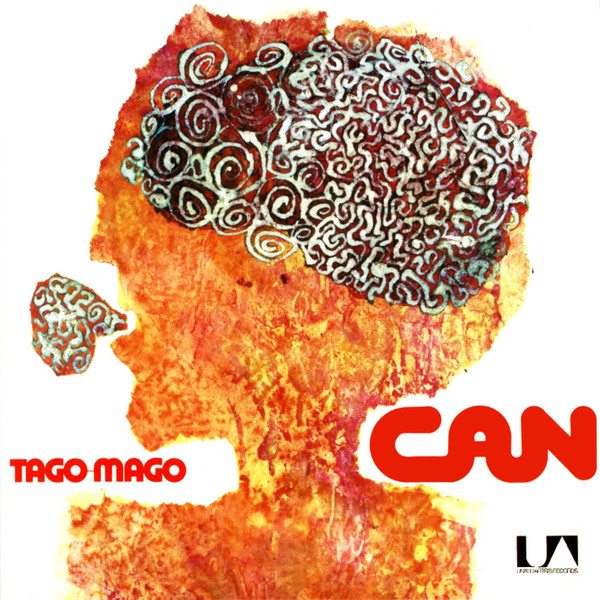
With Suzuki, Can cut the record that defines them: Tago Mago (1971), a double LP made at their Inner Space studio. It is music built by subtraction and editing — Czukay cuts hours of improvisation down until the shape appears. "Halleluwah," eighteen minutes, is above all a vehicle for Liebezeit's drumming, a hypnotic pulse that never lets go; across the second half, "Aumgn" and "Peking O" slide into pure abstraction, treated voices and electronics. When a piece written for a German TV thriller, "Spoon," unexpectedly becomes a domestic hit, the band spend the money fitting out a new studio in an abandoned cinema.
That cinema, in Weilerswist, becomes the new Inner Space. There they make Ege Bamyasi (1972), tighter and funkier, and Future Days (1973), where the same pulse turns almost ambient, years ahead of its time. At the centre of it all is Jaki Liebezeit: a drummer who plays like a human machine, able to hold a groove for twenty minutes without a flaw and yet never sound mechanical. When Suzuki leaves in 1973, Can lose their most recognisable voice but not their method — they go on shaping improvisation like clay.
The book that shares its title with the Can album — David Stubbs's Future Days — is the fullest history of the scene written in English.

Neu!: the straight line
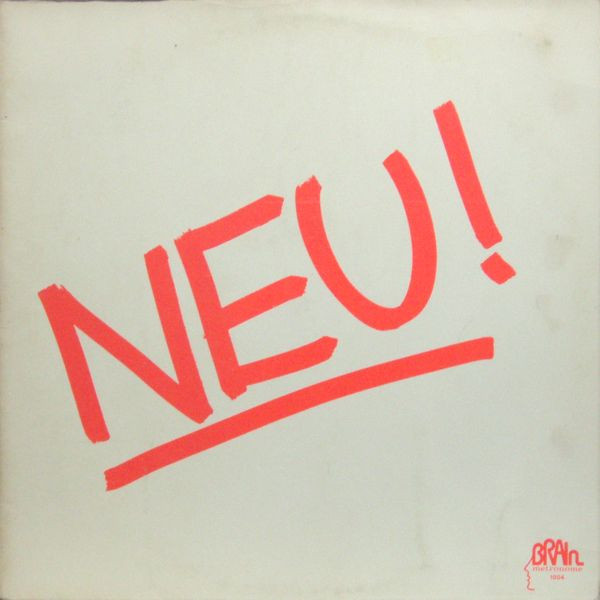
If Can are organised chaos, Neu! are geometry. Klaus Dinger and Michael Rother form the duo in Düsseldorf in 1971; both have passed through the earliest Kraftwerk and left in search of something more organic. Across four nights in December 1971, at Star Studios in Hamburg with Conny Plank at the desk, they record Neu! (1972), the album that codifies motorik in its barest form. "Hallogallo," ten minutes long, is the straight line made audible: Dinger holds an unbothered 4/4 while Rother's guitar piles up in layers. It is the sound of a drive down a motorway, and the metaphor is not idle — that is exactly what Dinger has in mind.
The Neu! legend lives off their limits too. For Neu! 2 (1973), out of money halfway through, they fill half the record with the same pair of tracks played back at different speeds, manipulating the tape by hand — a bankruptcy trick that now sounds like an avant-garde gesture. With Neu! 75 the duo split into two mirror halves: a luminous, near-ambient side from Rother, and a rough, hammering side led by Dinger and two drummers that prefigures punk by a year. Then their paths divide — Rother toward Harmonia, in partnership with Cluster, and a hushed solo career; Dinger toward La Düsseldorf, which David Bowie would call "the soundtrack of the eighties."
Kraftwerk: the man who becomes machine
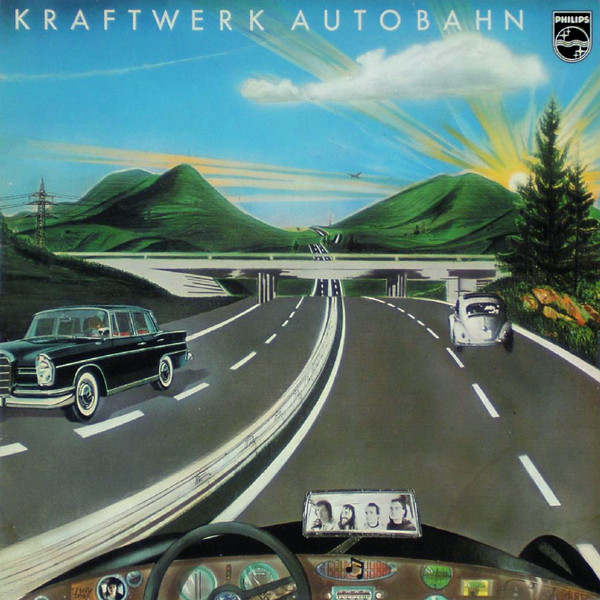
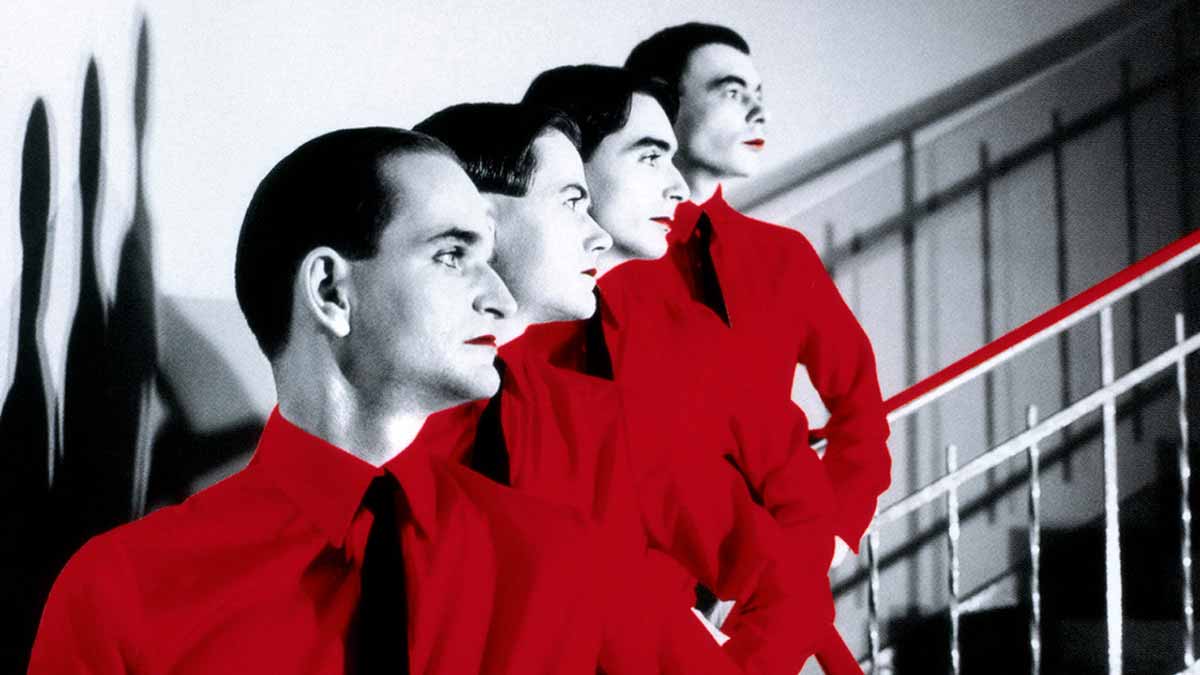
Ralf Hütter and Florian Schneider start from the same broth — Düsseldorf, improvisation, treated acoustic instruments — and end up somewhere else entirely. The Kraftwerk we know begin their official story in 1974: the three earlier albums — Kraftwerk (1970), Kraftwerk 2 (1972) and Ralf und Florian (1973) — are still experimental krautrock, with flute, organ and live drums, and the band have since disowned them as "archaeology," never reissuing them or putting them on streaming. The turn comes with Autobahn (1974). The title track runs twenty-two minutes and remakes motorik as something new: a motorway journey rendered wholly in synthesizers and vocoder, recorded with Conny Plank's help. It is above all the shorter single edit that reaches the American and British charts — a German record, sung in German, on Anglo-American radio.
From there Kraftwerk stop hiding the machine and make it the subject. Radio-Activity (1975), Trans-Europe Express (1977) and Die Mensch-Maschine (1978) build a complete aesthetic: the man-machine, the perfect electronic pulse, the voice filtered until it becomes circuitry. It is the end of krautrock as rock and the start of something else — the direct line to Detroit techno, to synth-pop and to hip-hop, when in 1982 Afrika Bambaataa builds "Planet Rock" on the skeleton of "Trans-Europe Express."
Conny Plank, the invisible thread
One name runs through almost all of these stories, and almost never appears on the sleeve: Conny Plank. An engineer and producer, he works on early Kraftwerk and on every Neu! record, shapes the sound of Cluster and Harmonia, and from his studio — a converted farmhouse in the countryside near Cologne — passes much of krautrock through his hands. Plank does not merely "record": he treats tape as an instrument, builds spaces, dirties and electrifies sounds. When, at the end of the 1970s, a new generation wants that tone — DAF, Ultravox, the early Eurythmics — it comes looking for him. If krautrock has a sound recognisable beyond the individual bands, much of it is his.
Why the German originals cost
For a collector, krautrock is also a minefield of pressings, reissues and bootlegs — and here the three bands tell three opposite stories. Can are the most approachable: Tago Mago came out in 1971 as a gatefold double LP on the German United Artists, and has been reissued many times since, now mainly on Spoon/Mute with careful masters. An original UA copy in good shape costs money, but it is not unfindable.
Neu! are the extreme case, and the story is worth telling. For most of the 1990s their three albums were out of print, hostage to a feud between Dinger and Rother. Into that vacuum came the bootlegs — above all those of Germanofon, a Luxembourg pirate label — while Julian Cope's Krautrocksampler (1995) sent demand soaring. Only in 2001 did the three records return officially, on Grönland in Europe and Astralwerks in the US; the Neu! Vinyl Box of 2010 tidied up the rest. Original 1970s Brain pressings stay rare and dear precisely because of all this.

Kraftwerk, finally, are collected by subtraction. The first three albums, the pre-Autobahn ones, the band have disowned and will not reissue: to own them on vinyl you must go to originals, and that is where prices climb. From Autobahn onward the catalogue is orderly and available, with official remasters overseen by the band themselves. A working rule: if you want the listening, start with the modern reissues; if you want the object, it is the German originals — United Artists, Brain, Philips — that make the difference.
The legacy
None of these bands sells much, at the time, outside Germany. Yet few musics have left so wide a bloodline. David Bowie and Brian Eno listen to all of it: Bowie's Berlin trilogy (Low, "Heroes") is made in dialogue with this sound, and "V-2 Schneider" is an open tribute to Florian Schneider. From there the line branches out.
Krautrock is not a genre. It is a refusal that became a method. — Groov-illa
The lesson of Can, Neu! and Kraftwerk is that you can build a future by refusing a past. They had no roots, and made an advantage of it; they could not play the blues, and invented another way of moving forward. That straight, tireless beat is still the sound of forward motion — proof that the most radical thing, sometimes, is simply not to look back.