The Velvet Underground and the banana
500 copies sold on release. Millions of bands born after. The story of the most influential rock album ever made.
Lou Reed wrote about what he saw. Not what he imagined, not what he wanted to say — what was in front of him every day in lower Manhattan: addiction, desire, the particular loneliness of people who had deliberately placed themselves outside ordinary life.
That decision — to treat the subject matter of the street and the underground as legitimate lyrical territory, without editorial distance, without redemption arc — is where this record begins and where it has never been fully matched. John Cale brought something the rock format had no framework for: he had spent years in drone minimalism with La Monte Young and understood noise and sustain as compositional tools, not as failure. Maureen Tucker hit things with mallets and no swing, standing up, indifferent to groove in the conventional sense. Nobody else sounded like this because nobody else had put these four people in a room.
Warhol's banana
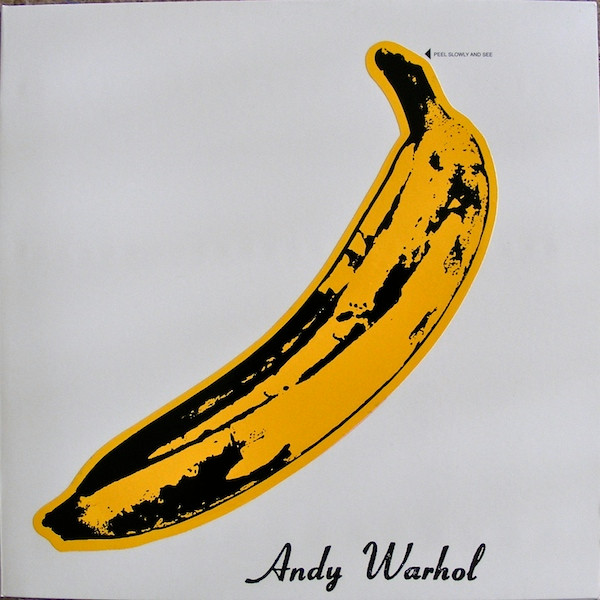
The cover is a banana. Warhol's name is bigger than the band's. Both of those facts matter. The banana — yellow on white, peelable on early pressings to reveal a pink one beneath — is not a provocation. It is the Warhol move applied to records: the ordinary object elevated by context, the act of peeling as a literal instruction to look for what's underneath the surface.
Warhol didn't produce the record in any conventional sense. He attended sessions, offered opinions, functioned as a presence. What he provided was cultural permission and the distribution leverage that came with his reputation. In 1967 that was worth more than studio time. First pressings with the intact peelable sticker are among the most sought-after records in the world: Near Mint copies clear three thousand euros on Discogs when they appear. Find one with the sticker gone and you're looking at sixty to two hundred. Still worth it.
The silver warehouse at 231 East 47th Street ran on a principle Warhol never quite articulated but consistently applied: dissolve the line between making something and living inside it. Underground celebrities, drag queens, addicts, gallerists, film-makers and journalists occupied the same space. The Velvets performed during the Exploding Plastic Inevitable — strobe lights, films projected directly onto the band, dancers, simulated whippings on stage. It is the least rock-and-roll context in which a rock band has ever developed a vocabulary. Which is, of course, exactly why it worked.
What was inside the record
Sunday Morning is a misdirection. Celesta, gentle strings, Reed's voice barely audible — it sounds like the record is going to be gentle with you. It isn't. The sweetness is real, not ironic, but it is the sweetness of early morning after something you would rather not name, and the feeling underneath it is damage. I'm Waiting for the Man arrives next: three piano chords hammered without finesse, the lyric a near-verbatim account of scoring heroin in Harlem, the tempo relentless. Heroin is where it goes furthest — eight minutes, the tempo accelerating and slowing like respiration changing under a substance. Cale's viola climbs into pure noise and pulls back. Reed sings without a position, without judgment, without the implicit reassurance that this is a cautionary tale. It is a description. Venus in Furs builds a four-minute drone from Sacher-Masoch. All Tomorrow's Parties gives the vocal to Nico — her German intonation over Tucker's martial pulse creates the most precise sound of inevitable melancholy that 1967 produced.
«Everyone who bought one of those five hundred records went out and formed a band.» — Brian Eno, 1982
Why nobody bought it
Sgt. Pepper's came out three months later. The timing is instructive. While the Beatles were presenting rock as a fully formed art form — ambitious, orchestrated, self-consciously historical — the Velvet Underground's debut was failing to chart, failing to get radio play, and failing to find an audience large enough to matter commercially. MGM's Verve division released it on 12 March 1967 with minimal promotion and visible anxiety about the lyrical content. The «500 copies» figure that has circulated for decades is almost certainly wrong — the actual number was probably a few thousand — but not wrong in spirit. It sold badly.
Failure, in this case, was a filter. The people who found the record in 1967 were, almost by definition, artists, musicians, people already operating outside the mainstream who were actively looking for something the mainstream wasn't supplying. They did not buy it passively. They hunted it, then they pressed it on anyone they thought could hear it. The band continued for six more years, losing Nico, then Cale, then Reed himself, and dissolved in 1973 without a single commercially successful record.
The bands that would not have existed
What the Velvets transmitted was not a style but a permission — the permission to treat rock lyrics as literature, to treat noise as a compositional tool equal to melody, to make records that did not resolve into something comfortable. The Ramones took the speed and the urban minimalism. Bowie took the idea of the performer as constructed persona. Joy Division took the relationship between beauty and dread. Patti Smith took the confidence that a rock song could carry the weight of poetry. Sonic Youth took the alternate tunings and the controlled feedback. Kurt Cobain cited I'm Waiting for the Man specifically as the record that convinced him musical competence was optional.
Which pressing to find
The original Verve (V6-5008, 1967, MGM green label) is the collector's object. Intact peelable banana means three to five figures depending on condition and stamper — the community has mapped the variants. Banana-stripped copies land between sixty and two hundred euros. Mid-Seventies MGM represses (later V6-5008 variants, VLP-9184) are sonically equivalent and easier to find clean. The 2002 Sundazed 180g is the modern reference: the mastering decision to leave Wilson's original balance intact while cleaning up the surface noise is correct — the record sounds like it was made cheaply and deliberately, not like a record that has been rehabilitated. For most purposes, the Sundazed is enough.
«The record that sold nothing has become one of the most cited, most studied and most imitated records in rock.» — Groov-illa
The Velvet Underground — The Velvet Underground & Nico
- Pressing
- Original Verve V6-5008 (1967) · Recommended: Sundazed 180g (2002)
Which pressing? Check it on Discogs ↗
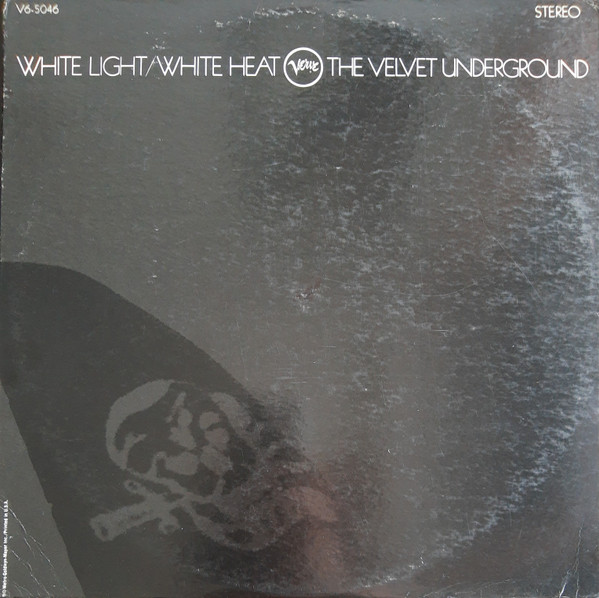
The Velvet Underground — White Light/White Heat
- Pressing
- Original Verve V6-5046 (1968)
Which pressing? Check it on Discogs ↗