Who owns a song
Tribute bands, prog, and the point where imitation stops producing originals: the tribute that generates versus the one that only conserves is the most honest gauge of a culture's health
There is a book of sheet music still doing the rounds in rehearsal rooms. It is ring-bound, black-and-white cover, long out of print — a rare edition once pressed for the Japanese market only. Inside are eight Genesis pieces, each with its starting page number printed after the title: The Knife on page 8, Watcher of the Skies on page 33, Firth of Fifth on page 51. A hundred and twenty-eight pages in all. On the cover, a line of ad copy: "Ideal for Cover and Tribute Bands."
Stop on that object for a moment, because it contains the whole question. A rock song reduced to notation, paginated like an orchestral score, sold to the musicians who will have to play it faithfully. Not a record — a score. The music that received opinion files under rebellion, improvisation and the unrepeatable is presented here exactly as Beethoven is presented: a written text to be read and performed again from the top.
So who owns Firth of Fifth? Copyright law answers: Banks, Collins, Gabriel, Hackett, Rutherford. But that Japanese score answers differently. It says the song belongs to anyone who can read it and play it. And the audience filling a theatre in 2026 to hear it performed by a tribute band is not paying to see Genesis — Genesis are not there, and are not coming back. They are paying to hear that text, played well, by whoever can play it.
This is the story of how rock became a repertoire to be performed rather than a scene that produces, why prog is the place you see it most clearly, and of a distinction almost nobody draws: between the tribute that generates and the tribute that conserves. They are identical in form and opposite in function, and the difference between them is the best available diagnosis of the health of a musical culture.
A market nobody writes about
Start with the numbers, because they are more interesting than any opinion.
The tribute circuit is a real economy, not a hobby, and it is largest precisely where the original artists are furthest out of reach. In Italy — a useful test case, and we will come back to why — trade estimates put the number of "faithful" tribute acts, the ones reproducing a specific artist with something like philological intent, at a few hundred, sitting inside a universe of many thousands of general cover bands. No official census exists, so the figures are indicative. But the ratio is itself an argument: the faithful, declared reproduction of one specific artist is the artisanal exception inside an ocean of generic entertainment. The serious tribute is a minority, not the rule.
And they work, in the fiscal rather than the romantic sense. The best-organised tribute acts tour dozens of dates a year and support their members full-time; ticket prices for the strongest of them sit in gig territory, not pub territory. The structural reason is blunt and worth stating without euphemism: the tribute market thrives in proportion to the age of the audience. Where there is a large public nostalgic for the rock of the sixties and seventies, and where those bands have either dissolved or stopped touring, the tribute meets the demand with a simple offer — the closest available experience to a concert that can no longer happen. Pink Floyd do not play together. Queen without Mercury are a different thing. The tribute occupies the gap.
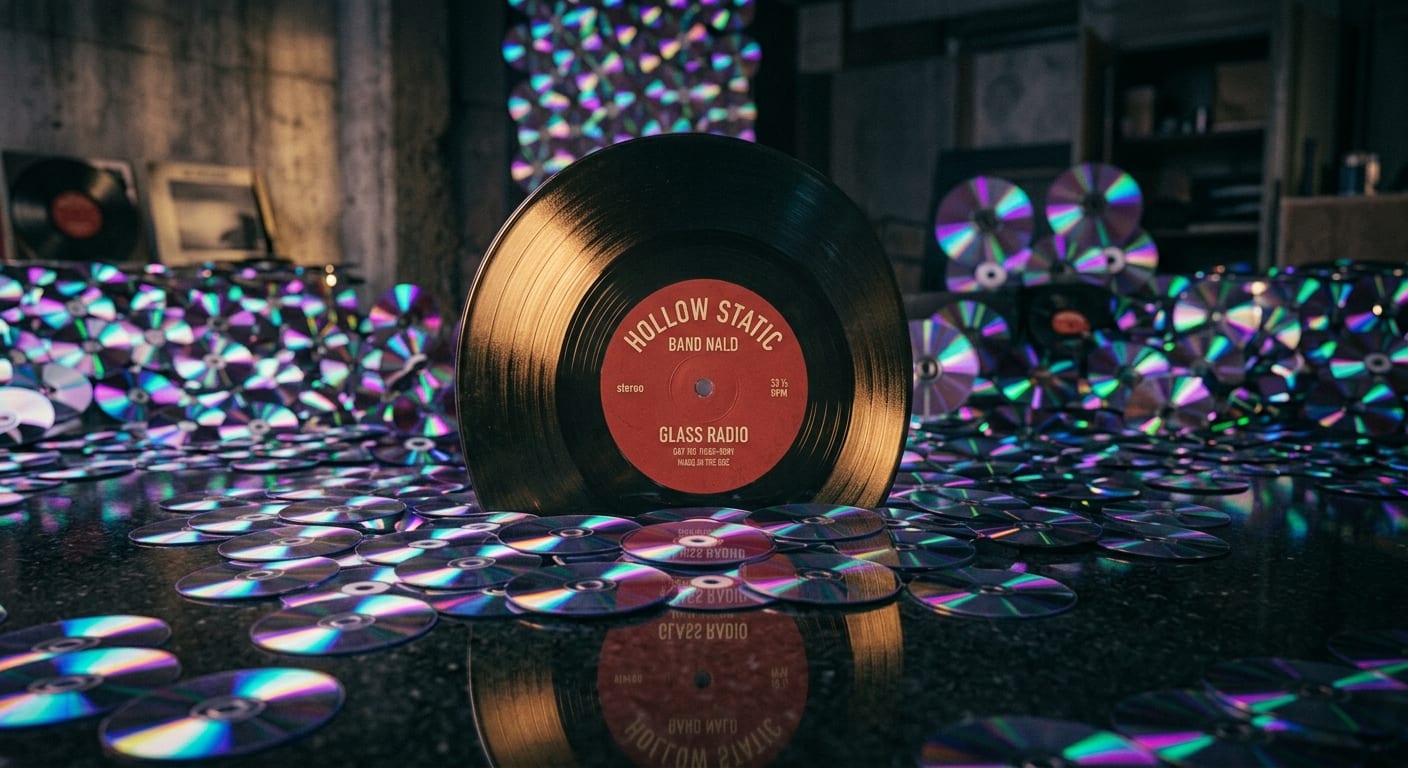
Here is the figure that ought to unsettle anyone who loves records. Across the same years in which the physical music market has been shrinking, live performance of the historic repertoire has held up a real slice of the music economy. The record collapses as an object while the song survives as performance. Vinyl becomes a collector's relic at precisely the moment the tribute becomes a trade.
Hold those two movements together, because the whole argument starts there. They are not separate. They are the same thing seen from two sides: when an artist vanishes from the present, the music splits into two forms of preservation. The record, which fixes it as an object. And the tribute, which revives it as a rite. The collector and the tribute band are two priests of the same cult — the cult of an artist who is no longer here.
And they largely share a congregation. The person who pays to watch a Pink Floyd tribute perform The Dark Side of the Moon is, in all likelihood, the same person who keeps an original pressing at home and can tell one mix from another. These are not two markets. They are two expenditures of a single desire: the record satisfies private possession, the relic held in the hand; the tribute satisfies collective experience, the rite lived in a room with others. A magazine about record culture that ignored the tribute would be describing half its own reader and pretending the other half does not exist.
Why prog is the perfect case
Of all the genres a tribute band can perform, prog poses the question in its purest form. And not by accident.
Progressive rock is, by constitution, the most written music in the history of rock. It was born with the declared ambition of approaching art music: long structures, odd metres, thematic development, parts conceived as movements rather than verses. Music like that is not handed down by ear the way a twelve-bar blues is. It is transcribed. Which is why bound Genesis scores exist at all: because that music is a score, and was one already when Genesis were playing it for the first time.
A genre born as notation is a genre pre-adapted to performance by others. That is the structural reason — not the nostalgic one — that prog tributes thrive. Shows dedicated entirely to the prog of the golden years sell out across Europe, offering Genesis, ELP, Yes, King Crimson, Jethro Tull and Pink Floyd played by technically formidable musicians. It is no coincidence that prog attracts players of that calibre: it is difficult music, and the difficulty is half the draw. Performing Karn Evil 9 in full is an orchestral undertaking. Part of the audience is there to see whether they can pull it off.
But prog carries a second layer, and this is where the piece turns from description into argument. And the layer shows most clearly from outside England — which is why the Italian case is worth importing.
Italian prog was itself born as tribute. This is not a polemical charge; it is documented, and its own chroniclers concede it. Premiata Forneria Marconi — PFM, the one Italian prog band to chart in America — were so bound to the Anglo model that you need only set the guitar figures of their early work beside "21st Century Schizoid Man" to hear where the language came from. Critics at the time dwelt insistently on how closely the Italian bands copied their English colleagues. The genre arrived in Italy as import and as emulation.
Now watch the short circuit that holds the whole article together. When an Italian tribute band performs Genesis today, it is honouring an English model. But when PFM performed their own music in 1972, they were already honouring the same English model. A Genesis tribute band and PFM in 1972 are, in a sense, making the same gesture: both translate King Crimson and Genesis into an Italian performance. Three levels of reproduction stacked one on the other, and nowhere at the bottom of the stack anything you could call the absolute original.
Except the two gestures are not the same. And the difference between them is everything.
The tribute that generates
Out of PFM copying King Crimson came Banco del Mutuo Soccorso. Out of it came a scene — the one chroniclers call Italian prog — with its own magazines, festivals, labels and, in the end, its own language.
Because Italian prog, however much it began in emulation, did not stop at emulation. It grafted the English grammar onto a different tree: nineteenth-century melodrama, opera, Mediterranean harmony, and a different subject matter in the lyrics. Where the English built fantasy allegories — hobbits, crimson kings, imaginary worlds — the Italians brought loneliness, alienation, social criticism, the conflict with family and state. Banco's Darwin! is a concept album about evolution. It is not the disguise of an English model; it is an autonomous thought using an imported tool.
That journey is worth following to its logical extreme, because it is the paradox of the generative tribute at full stretch. PFM's second album drew the attention of Greg Lake, of Emerson, Lake & Palmer, and the Italian band ended up on Manticore, the ELP label. In 1973 came Photos of Ghosts — their Italian material re-recorded in English with new lyrics by Peter Sinfield, the very lyricist who wrote for King Crimson and ELP. It reached the Billboard 200, with airplay on American underground FM.
Trace that trajectory. An Italian band imitates King Crimson well enough to be adopted by their cousins in ELP, re-recorded with the words of King Crimson's lyricist, and shipped to America, where the Anglophone public — the original source of the whole thing — receives it as something new. The imitation has travelled back up the current to the spring and been recognised as original in the very place the model was born. This is the exact opposite of sterility. It is a tribute so accomplished that, for the receiving audience, it becomes an original in its own right.
It needs saying plainly, because it is counter-intuitive and it demolishes a cliché dear to this kind of magazine: imitation, in itself, is not a sign of sterility. Almost all music begins by imitating. British blues in the sixties was a misreading of American blues — too fast, too loud, the emphasis in the wrong places, because it was learned from records rather than in the room; out of that misreading came Led Zeppelin, which America then bought back as revelation. Italian prog was an imitation of English prog; out of that imitation came Banco. The copy is the ordinary way music reproduces and mutates. Anyone who dismisses a scene by saying "they copied" has mistaken the mechanism of life for a defect.
So the exhaustion is not in the act of paying tribute. Historically, the tribute has been an engine. PFM paid tribute and produced a new original, in the same gesture, at the same time.
The real question is different: what happens when the gesture stays identical but the engine cuts out?
The tribute that conserves
Take a Genesis tribute band in 2026. It performs Firth of Fifth note for note, with the same philological care PFM brought to their version of King Crimson. Technically it may be superior to PFM in 1972. The gesture, on the surface, is the same: take an English model and give it back to an audience.
But nothing comes out of this performance. No new Banco is born. No language is generated. There is no Darwin! at the end of this chain. There is another, perfect performance of Firth of Fifth, and then the audience goes home.
This is the tribute that conserves. And it is here, not in imitation as such, that the symptom of an exhausted culture hides.
The distinction is sharp and worth holding still, because it is the spine of the whole argument. The generative tribute takes a model and produces a new one, which can in turn be imitated. The conserving tribute takes a model and repeats it, and the chain stops there. The first is a link in a succession: PFM imitate King Crimson, someone will imitate PFM, transmission continues. The second is a terminus: the Genesis tribute band will never spawn a scene of bands imitating the Genesis tribute band. Nobody pays tribute to a tribute.
That is exactly the point.
A culture is alive as long as imitation produces new originals to imitate.
It is exhausted when imitation produces only further imitations of the same, ever more faithful and ever more sterile. The number of tribute bands does not measure the vitality of a musical culture. It measures the depth of its historic repertoire and the width of the vacuum left by the originals. A few hundred faithful tribute acts do not say the music is alive. They say there is an enormous body of work to perform and nobody writing tomorrow's body of work with the same grip on the public.
Prog makes this visible because it is the genre where the chain snapped most conspicuously. In the seventies it was a generative machine: from King Crimson to PFM to Banco to dozens of lesser groups, each link produced another. Today it is a repertoire. It is performed the way Vivaldi is performed — with respect, with skill, with theatricality — but nobody writes prog that generates further prog, not in that form and not with that audience.
Rock as classical music, and why that is a poisoned compliment
There is a prediction that has been circulating for years, and in its noblest form it runs like this: in future, anyone wanting to hear the soundtrack of this era will have to enter a concert hall, exactly as we now do for Mozart and Beethoven.
It is a seductive image, and there are good reasons to take it seriously. The model holds. Bach has not taken a stage in three centuries, yet he is performed every night across the world, by players who study for years to do him justice, before audiences paying to hear that text well interpreted. Swap "Bach" for "Genesis" and "concert hall" for "theatre" and you have described an evening of prog tributes. Prog, more than any other rock genre, already has everything the transition requires: the score, the executive difficulty, the canonical repertoire, the venerating public.
And here the outside case earns its place again. English prog, at home, was often niche: bands that scraped a hundred people a night in London found themselves, in Italy, before full arenas. The Italian public always treated Genesis, ELP and King Crimson the way one treats the great composers — with a conservatory's devotion, not the pop scene's disposable enthusiasm. That liturgy existed already in the seventies. The tribute band did not invent it; it inherited it from an audience that had always heard prog as classical music in disguise.
But this is why "rock is the new classical music" is a poisoned compliment, and it should be said without softening.
When a genre becomes repertoire, it has stopped being a force. Classical music is performed because it is no longer composed in that language: nobody today writes late-Romantic symphonies that enter the canon beside Brahms, and the few who try are producing exercises in style, not living works. To "become classical" is to enter the museum. It is an honour granted to the dead. To say prog is now classical music is to say that prog, as a generative practice, is finished — that its history is closed and only the performance remains.
The tribute, on this reading, is not the executioner. It is the gentle undertaker: the keeper who tends the grave and opens it to the public. It does honest, necessary work, and often does it superbly. But its very existence in this form — philological, conservative, curatorial — certifies a death. It kills nothing. It records a death already occurred.
In defence of undertakers
Here we must stop and say the other half, because a piece that stopped at that would be dishonest, and would fall into the intellectual contempt that is the easiest vice in writing on this subject.
The tribute band is, in its way, the most honest form of live music left. And this is not a provocateur's paradox; it is an observation.
A tribute does not pretend. It states exactly what you came to hear and delivers it. There is no swindle of the "new album" nobody wanted, slipped in mid-set while the crowd waits for the songs it knows. There is no pose of an artist faking inspiration thirty years after losing it. There is no emotional blackmail of the reunion tour, four men tolerating one another for a season at enormous fees. There is a transparent contract: you want to hear The Dark Side of the Moon performed with care, I perform it with care. Nobody lies.
Set it against the realistic alternative, which is not "the real Pink Floyd concert" — that does not and cannot exist — but the old artist dragging himself round on the strength of his own legacy, giving the audience a tired and diminished version of what he was. Between a young, devoted tribute playing Echoes in full with energy and the original reduced to himself, dispatching it in a medley, artistic honesty does not always sit with the original. Sometimes respect for the music is more alive in those who perform it out of devotion than in those who own it by seniority.
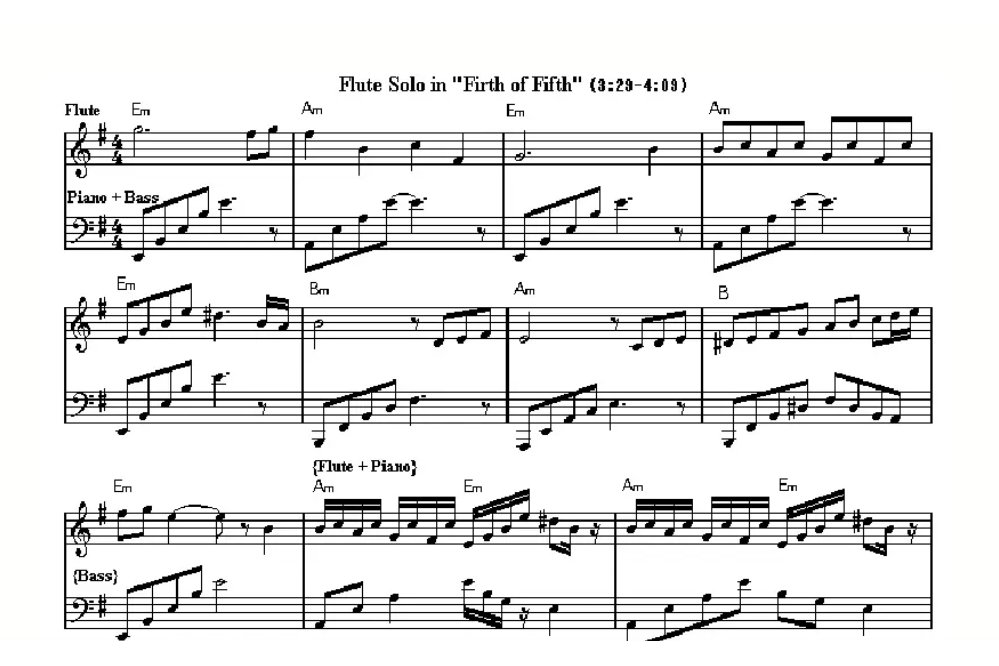
There is also a question of competence that inverts the usual hierarchy. In prog, the tribute band must command a technical facility that often exceeds what is asked of anyone writing new music. To reproduce Firth of Fifth means a keyboard player who can execute that piano solo, a guitarist equal to Hackett, a rhythm section that holds the metric changes without a net. This is not karaoke; it is a conservatory examination. The prog tribute audience — demanding and knowledgeable — comes partly to check the execution: whether the Mellotron is the right one, whether the attack of Watcher of the Skies has the correct sound. There is a philological rigour close to that of classical performance, and to condescend to it is to have missed how hard it is. The prog tribute rewards a virtue — executive fidelity — that rock, in its mythology, has always pretended to despise while demanding it in the studio.
And there is the social function a music magazine should not sneer at. For a great many people the tribute is the only physical access to music they would otherwise know only from a file. It is where a twenty-year-old hears for the first time what Firth of Fifth means in a room, at real volume, with a real Mellotron — and perhaps works back from there to the records, the scene, the history. The prog tribute is often the front door to prog. Exactly as, for another generation, record collecting is the front door to serious listening. Two liturgies of the same cult, again.
So the ambivalence is real and must be kept whole, not dissolved into a consoling synthesis: the tribute is at once the most honest form of live music left and the symptom of a culture that has stopped generating. The two do not cancel. They coexist in the same theatre, the same evening, while the band plays Watcher of the Skies and the audience closes its eyes.
The tribute to the living, and who owns a song
Everything so far rests on a convenient assumption: that the tribute is born of absence. The artist is gone — dead, dissolved, retired — and the tribute band conserves the repertoire. But there is a phenomenon that cracks the assumption: the tribute to an artist who is very much alive and working.
The Italian scene is full of tributes to living, active, arena-filling artists — performers you could, in principle, go and see yourself. Why should a tribute exist to someone still on the road?
The answer dismantles the idea that the tribute is merely a surrogate for absence. The tribute to the living artist fills not a vacancy of mortality but a vacancy of access. The real concert is a rare, expensive event in a distant stadium, once a year if you are lucky. The tribute is near, cheap, repeatable, in a provincial theatre or a village festival. It does not compete with the original: it occupies the space the original, grown too large, has left uncovered below. It is the weekday liturgy beside the sung Sunday mass. And this says something about the "rock as classical music" model we left hanging: living composers, too, are constantly performed by others. To be performed by third parties while still alive is not a sign of artistic death — it is the definitive sign of having entered the repertoire. The living arena-filler is already canon, and canon is performed.
But the case hides a further vertigo, and here the question of who owns a song reaches its sharpest point. It is common, in these Italian shows, for the guest of honour to be an actual member of the original band — a musician who wrote and played the very sound the tribute reproduces, now appearing as a guest within the tribute to music that is partly his own.
Stop and picture that stage. There is a tribute band faithfully reproducing a sound. And beside it stand the musicians who invented that sound, now guests in the homage to their own work. The co-author of the song, appearing as a special guest in a tribute to the band he was in, is a logically impossible figure — the original guesting for his own copy — and yet it happens, with a date and a box office.
So who owns the song? Copyright says the writers. The stage says: whoever performs it well, including the writer himself, who on that evening is no longer "the author" but a guest performer of his own piece, on a par with the tribute band's players. Formal ownership and performative truth come apart, and they come apart in public.
It is the same gap every collector knows from a cover that beats the original. Johnny Cash did not write "Hurt"; Trent Reznor of Nine Inch Nails did. But Cash's 2002 recording, made by a man near death, so rewrote the meaning of the song that Reznor himself said it no longer felt like his — that hearing it, he had the sense it had become someone else's. Copyright did not move an inch: "Hurt" remains Reznor's. But the song, in the only sense that matters to a listener, changed hands.
Here is the point that binds the whole piece, and it bears directly on anyone reading a magazine about records.
A song has two owners, and they never quite coincide.
There is the one who owns it by contract — the writer, the publisher, the rights holder printed on the back of the sleeve — and the one who owns it by performance, who has given the version the public hears as definitive. Vinyl records the first kind of ownership: names, shares, publishers, the notarial paperwork of the song. The tribute stages the second: the song as act, belonging to whoever makes it sound now, in this room. The collector keeps the deed of ownership. The tribute band exercises actual possession. Two faces of the same object, once again — and the writer guesting in his own repertoire is the short circuit that makes them touch.
Session players, or the real band that never existed
One last figure overturns the question completely, and it is worth closing on, because it casts doubt on the very word we began with: "original."
When prog tributes bring on, as guest, a session player who actually played on the original records — it happens, and it is the moment the most knowledgeable part of the audience holds its breath — a paradox forms on stage. The musician who recorded the original part is playing inside a band that imitates him. He is source and copy at once. His presence is meant to guarantee authenticity, but in fact it complicates it: if the original can be a guest of the copy, then the distinction between the two was never as solid as it looked.
Prog and rock generally are full of these cases, because much of what we hear on the classic records was never played by "the band" in the mythological sense. There were session men — musicians paid once, often uncredited, whose work became the sound of an era without their names ever appearing. The "real band" the tribute venerates is partly a fiction: under the sleeve with four faces there were, not rarely, other hands.
Which takes the question to its floor. If the original sound the tribute reproduces was itself partly produced by anonymous performers executing what the artist asked for — then the chain of imitation does not begin with the tribute band. It begins in the studio, on day one. And it does not stop there: whoever remixes those tapes today decides all over again how the original should sound — the trade we cover in Steven Wilson and the Remaster Industry. There was never a pure moment of the original, prior to and above all performance. There was always someone executing someone else's vision. The tribute band is not the degeneration of an authentic origin; it is simply the most visible and most honest link in a chain of performances that never had a true first link.
What is left on the table
Return to the object we started from: the Japanese Genesis score, "ideal for cover and tribute bands," with Firth of Fifth on page 51.
That object is the material proof of the thesis. A rock song that exists as a numbered score is a song that has already made the leap into repertoire. It is not waiting to become classical music: it already is, in the form in which it is handed down. And the collector hunting the original Genesis pressing and the musician buying that score to play them live are, at bottom, making the same gesture toward the same vacuum — keeping alive, by two different routes, something that as a generative force has already gone out.
The question worth closing on is not whether tribute bands are legitimate. They are, and Italian prog — born imitating King Crimson and capable of producing Banco — proves that paying tribute was for a long time a fully creative act. The question is more uncomfortable, and it concerns the present rather than the past.
If a musical culture is measured by its capacity to produce new originals to imitate, and if the signal of its exhaustion is the moment imitation stops generating and begins only to conserve — then we should look at today's scene and ask not how many tribute bands exist, but how many of today's bands will be paid tribute in thirty years. Who is writing, now, the repertoire a tribute band will perform with philological devotion in 2056? If the answer comes easily, the culture is alive. If we have to stop and think, and begin naming names in an uncertain voice, then the museum is already built — and the tribute bands are not its vandals but its first, honest keepers.
Principal sources: Italian tribute-market figures and estimates from Il Post (2026) and Articolo21 (2018), indicative and to be verified pre-publication in the absence of an official census; on Italian prog and PFM, Wikipedia together with OndaRock and Rolling Stone Italia features; on the living-artist tribute cases, Italian trade and local press. Reznor's remark on "Hurt" is well known and widely reported, but should be verified against source if quoted directly.