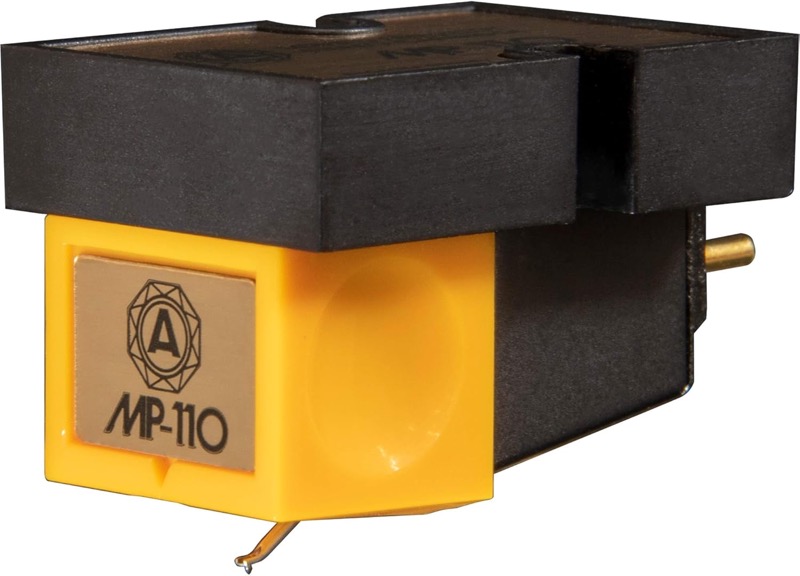
Some people fit the Ortofon 2M Red and wonder whether anything built a different way exists at the price. One answer is the Nagaoka MP-110: same class, a different design, with an induced permalloy. This page explains what sets it apart technically, what published reviews say about it — they do not describe it as a warm cartridge — and who it is the right cartridge for.
Context
Nagaoka has made needles and cartridges in Japan since 1947 — eighty years of styli — and it is one of those brands collectors pass around like a secret. The MP name is not "moving magnet" in the usual sense: it stands for Moving Permalloy, an induced-magnet design in which one of the magnets is replaced by a much lighter nickel-iron alloy (permalloy), activated by a powerful samarium-cobalt magnet. Lower moving mass, and in theory more agile tracking.
The MP-110 inherits the mantle of the classic MP-11 and is the entry rung of an all-Nagaoka ladder: MP-110, MP-150, MP-200 and beyond.
Design & build
The induced-permalloy design is the real technical difference from a standard moving magnet: less weight in the moving part, which is where Nagaoka pins its character. The cantilever is aluminium, the stylus a superfine elliptical with a 0.4×0.7 mil radius — finer than the tipped elliptical the 2M Red carries. The body weighs 6.5 grams, the mount is the standard half-inch.
For the money there is real technology underneath: that samarium-cobalt magnet is the same principle used in far dearer cartridges. Nagaoka quotes a break-in period of around 30 hours.
What reviewers say
The sound character on this page does not come from our own listening: we report it from published reviews, with the name of the person who wrote them.
What Hi-Fi? (April 2010 review) describes it as bright and immediate, able to liven up a dull system, with sweet mids and detail and vocal delivery that are good for the price. The limits: the bass is light and could use more weight, and the treble is a little edgy, less refined than its rivals'.
Dagogo (Byron Baba, December 2021) finds it very sensitive to the phono stage: harsh with a cheap one, more natural with a better one. Against the Grado Prestige Silver it is more forward and more detailed; surface noise is low, bass decent, mids smooth, treble pleasant. It lacks the richness of pricier moving coils, but stays clear and never fatiguing.
Vinyl performance
Set within its 1.5-2.0 gram range, the MP-110 has a medium-low compliance that gets along with medium-mass arms.
The stylus replaces (JN-P110) and the cartridge is not thrown away. A practical note: let the roughly 30 hours of break-in that Nagaoka quotes pass before you judge it.
Value & competition
In the same class sit the Ortofon 2M Red and the Audio-Technica VM95E. We have not found a direct listening comparison between the three in published reviews. On the Nagaoka's character, the two reviews we cite describe a cartridge that is bright and immediate (What Hi-Fi?) or clear and more forward than the Grado Prestige Silver (Dagogo), not a warm one.
The upgrade stays in the Nagaoka family: the JN-P150 and JN-P200 styli fit the MP-110 body and, according to Nagaoka, improve its performance. But note — and here Nagaoka is explicit — fitting a higher stylus improves the result but does not turn the MP-110 into an MP-150 or MP-200: the body stays the same. For the full jump you need the higher cartridge.
In the vinyl chain
Standard half-inch mount: the MP-110 fits almost any arm, best on a medium-mass one given the compliance. It wants an ordinary MM phono stage at 47 kΩ — an iFi ZEN Air Phono 2 or a Rega Fono Mini is ideal.
A word on matching, from Dagogo: the MP-110 is sensitive to the phono stage, harsh with a cheap one and more natural with a better one. Set the tracking force within the 1.5-2.0 gram range and give it its break-in hours.
- Induced-permalloy design: low moving mass, a different way to build an MM
- Superfine elliptical stylus (0.4×0.7 mil), finer than the 2M Red's tipped tip
- Sweet mids and good vocals for the price according to What Hi-Fi?; clear and never fatiguing for Dagogo
- Replaceable, interchangeable stylus within the MP series
- Light bass and slightly edgy treble according to What Hi-Fi?
- Sensitive to the phono stage: harsh with a cheap one (Dagogo)
- Medium-low compliance: prefers medium-mass arms
Phono: any MM stage at 47 kΩ (iFi ZEN Air Phono 2 ~£129, Rega Fono Mini ~£90). Arm: standard mount, ideally medium-mass. VTF: within the 1.5-2.0 g range. Dagogo finds it sensitive to the quality of the phono stage. Upgrade: the JN-P150 stylus for a step up (it improves the result, without becoming a full MP-150).
Verdict
The Nagaoka MP-110 is for anyone who wants, at around a hundred pounds, a cartridge built differently from the usual moving magnets: induced permalloy, low moving mass, a superfine elliptical stylus and a ladder of styli to climb.
On sound, published reviews describe it as bright and immediate (What Hi-Fi?), clear and never fatiguing (Dagogo), with light bass and treble that What Hi-Fi? finds a little edgy. And it needs a phono stage up to the job: Dagogo finds it harsh with a cheap one.

