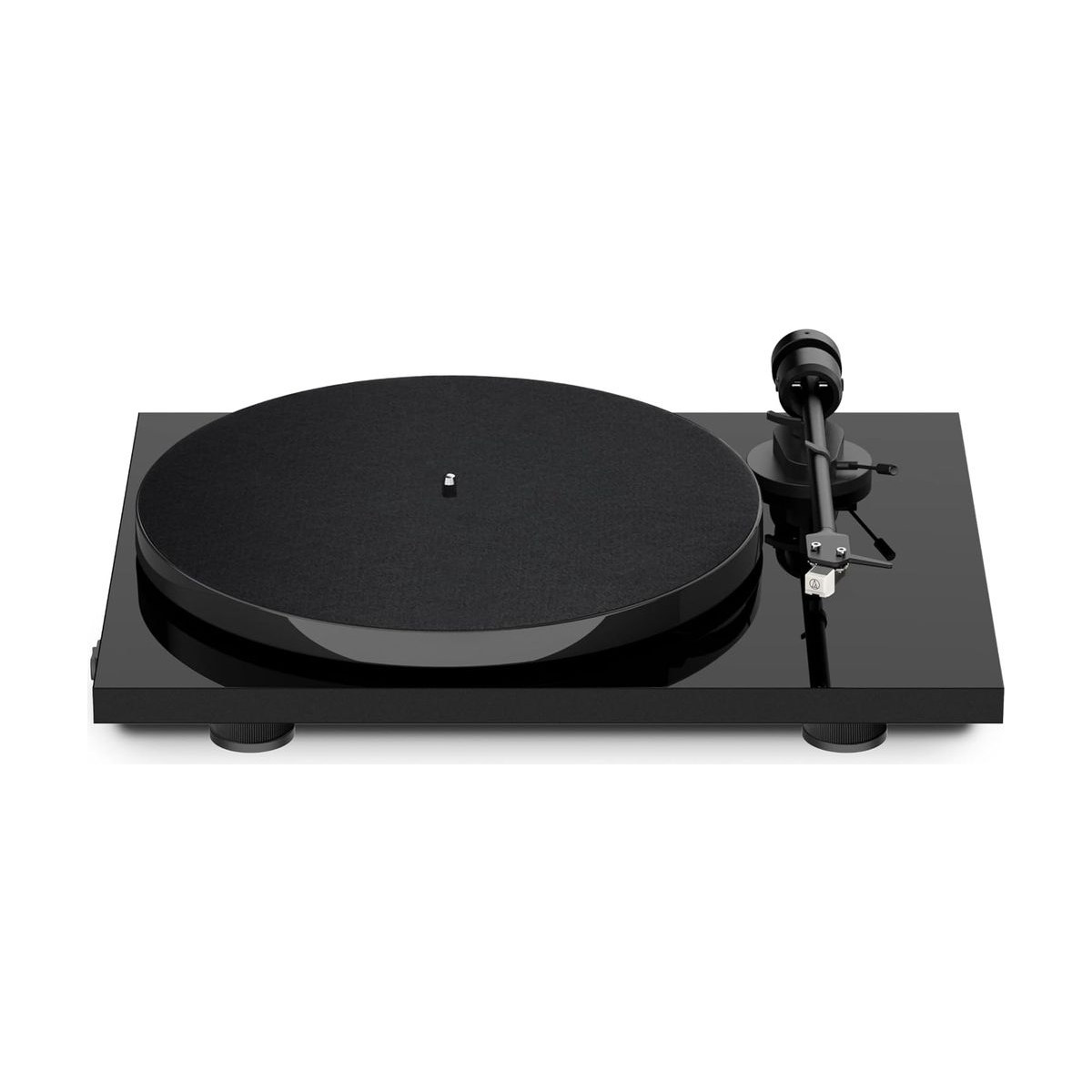
The E1 Phono is the newest of Pro-Ject's entry turntables, and its promise is right there in the name: a deck with the phono stage already inside, so it connects to any amplifier — even one without a phono input. It is the plug-and-play answer for anyone with a modern amp or powered speakers and no separate preamp.
First, a distinction that matters: it is not the E1 base (no phono) or the E1 BT (Bluetooth), and it is a different machine from the Pro-Ject T1 we have already reviewed — same brand, neighbouring price, but not the same object.
Context
Pro-Ject builds in Europe, and the E series is its newest entry line. It comes in three variants: the E1, base, with no phono; the E1 Phono, with a switchable built-in phono stage; and the E1 BT, with Bluetooth. This review is of the E1 Phono.
The design leans on a CNC-machined composite-fibre plinth, an 8.6" one-piece aluminium tonearm, electronic speed and an ABS platter with anti-resonance ridges. The supplied cartridge is an Audio-Technica AT3600L, fitted and set at the factory.
Design & build
Build is Pro-Ject's territory, and the E1 Phono does not disappoint. The composite-fibre plinth is CNC-machined with no hollow spaces inside, for resonance control; the one-piece aluminium arm with headshell is rigid and low-friction, factory-set for tracking force and anti-skate. ABS platter with ridges, felt mat, isolation feet, a DC motor and — a nice touch at this price — an acrylic dust cover with adjustable hinges.
The cartridge is the point to be clear about: it is an Audio-Technica AT3600L, an MM with a conical stylus. It is a basic cartridge. The reviews we cite below, however, tested units fitted with an Ortofon OM 5E.
What reviewers say
The sound character on this page does not come from our own listening: we report it from published reviews, with the name of the person who wrote them.
One caveat applies to all of them: the units reviewed were fitted with an Ortofon OM 5E, not the AT3600L listed on this page.
SoundStage! Access (Thom Moon, November 2022) describes a detailed sound, with good attack and release, a full range, good pace and timing and decent bass; the soundstage is wide but not deep, and there is a slight emphasis up top: bright, but not fatiguing. He finds the internal phono stage immediate and crisp, at times sibilant and with less bass drive than an external phono, but among the best built-in stages under $500. He also notes that the factory tracking force, measured at 1.4 g, was below the minimum, and reset it.
Digital Trends (Derek Malcolm, August 2022) reports a sound that was dull at first and then, after break-in and some adjustment, dynamic, with full, tight bass and mids and an orderly soundstage. The deck is light and skips if the speakers sit on the same furniture; Malcolm recommends a system with tone controls, and he listened with an equaliser, so his view of the tonal balance should be taken with caution.
TechRadar (Carrie Marshall, July 2024) tested the base E1, without the phono stage: she finds it quiet, with a well-defined stereo image, airy treble, tight bass, warm and lively vocals and good detail, and judges it better than the Audio-Technica AT-LP120X-USB.
Vinyl performance
The one-piece arm with headshell and the factory-set adjustments make the E1 Phono easy to live with and easy to grow. You can swap the AT3600L for an Ortofon OM or a 2M Red with nothing else to do: it is the first move I would make after a few months. It is still worth checking the factory tracking force with a stylus gauge, as SoundStage! Access found it below the minimum.
And the phono stage is switchable: you can turn it off and connect an external preamp when you want to take that step. It does not lock you in — you start from a single box and open the doors later.
Value & competition
The E1 Phono is the newer sibling of the Pro-Ject T1, and it is worth saying what really changes. Both are plug-and-play, with a built-in phono and electronic speed. The differences: the E1 has the newer CNC plinth, the one-piece arm with a detachable headshell — so you change cartridge more easily — and a switchable phono; the T1 has a glass platter and ships an Ortofon OM, and costs a little less.
There is no outright winner: they weight different things. The E1 Phono for the newer design, the switchable phono and the ease of upgrading the cartridge; the T1 for the glass platter and the Ortofon OM at a lower price. Worth comparing the two carefully, because they are close.
In the vinyl chain
Here is the E1 Phono's main argument, and it is practical: the switchable built-in phono stage means it connects to any amplifier — including the many modern integrateds and receivers with no phono input — or straight to powered speakers. It is the deck for anyone who has a good amp but no phono stage, and it is the same logic that simplifies the choices in our integrated amplifier ranking and underpins a system like the £800 one.
That the phono is switchable matters: you turn it off and use an external preamp when you upgrade, without being stuck. A note on distribution: outside Italy the E1 Phono goes mainly through specialist hi-fi dealers, and in the United States it is absent from the generalist channels. It is not a fault of the product — it is how entry-level hi-fi is sold.
- Switchable built-in phono stage: connects to any amp, even without a phono input
- CNC composite-fibre plinth and one-piece arm with headshell: serious European build
- Detachable headshell and factory settings: easy to upgrade the cartridge
- Electronic speed and an acrylic dust cover included
- The AT3600L conical-stylus cartridge is basic, and published reviews tested units with the Ortofon OM 5E
- Light: according to Digital Trends it skips if the speakers sit on the same furniture
- Pricier than the Pro-Ject T1, which has a glass platter and an Ortofon OM
- ABS platter is more modest than the T1's glass
- Outside Italy it is mainly at specialist dealers; no US generalist channel
Phono stage: not needed, it is built in and switchable. Amp: any, even without a phono input, or powered speakers. Speakers: Wharfedale Diamond 12.1i or Q Acoustics 3030i. Upgrade: replace the AT3600L with an Ortofon OM or a 2M Red, or switch off the internal phono for an external one.
Verdict
Buy the E1 Phono if you want a latest-generation Pro-Ject that connects to anything thanks to the switchable phono, and you do not mind upgrading the cartridge later. The conical-stylus AT3600L is a starting point to climb from, not a finish line.
And if the glass platter and the Ortofon OM of the cheaper T1 tempt you, weigh them against the E1: they are close. But for plug-into-anything simplicity with a clear upgrade path, the E1 Phono is an honest, clean choice.

