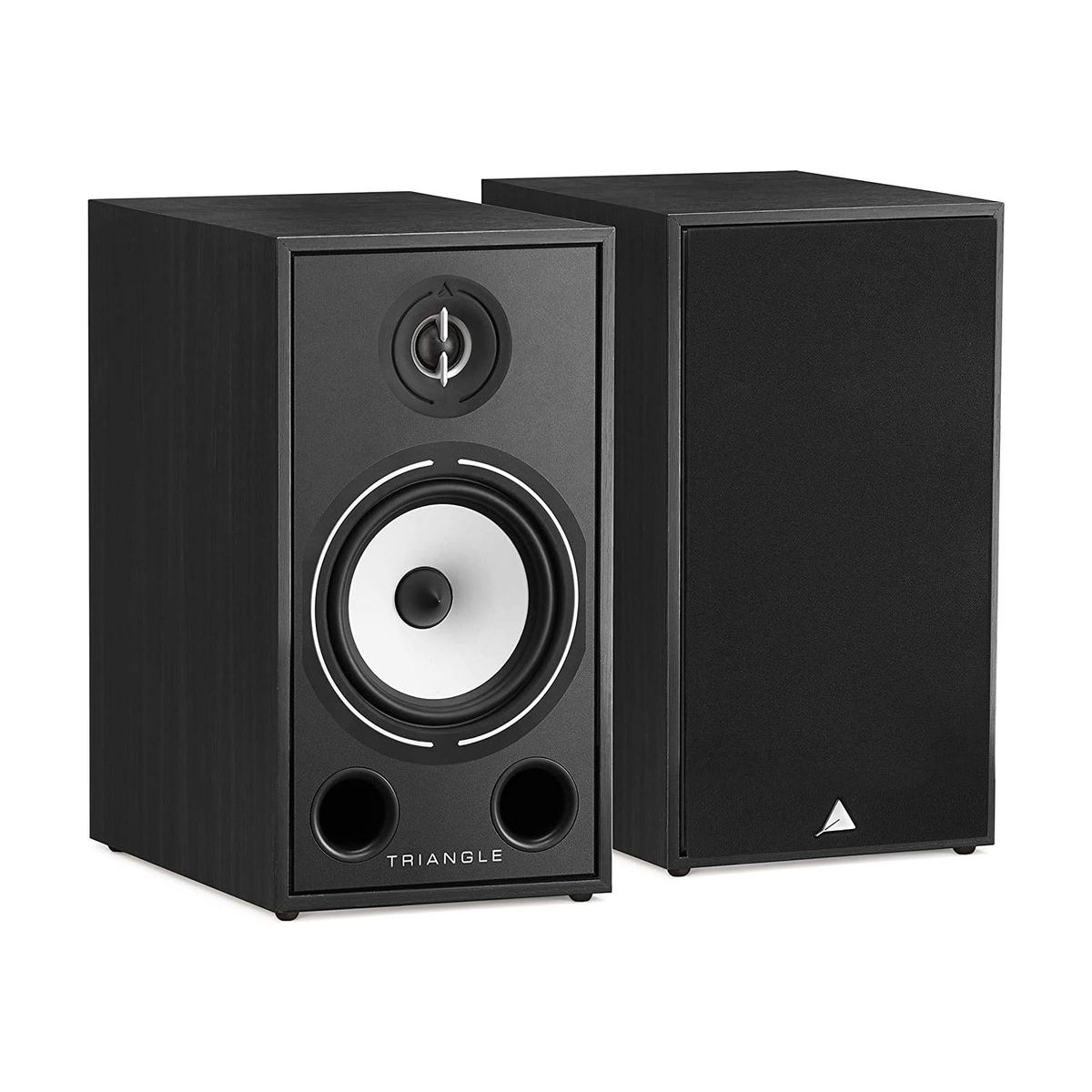
The Borea BR03 is the speaker our whole bookshelf ranking is built around, and it is number one for a precise reason: it is the easiest to drive for a modest amplifier: high sensitivity, an easy load.
It is the concrete answer to the question that matters for an entry system: which speaker to put in front of a 30-50 watt integrated. Prices are for the pair — this is how these speakers are sold — and the pair sits around four hundred euros.
Context
Triangle is a French maker, and the Borea range is its entry line. The BR03 is the middle bookshelf model: above the small BR02 and the new BR04 (the refresh with a redesigned port and double posts for bi-wiring). At its heart is a cellulose woofer derived from the higher Esprit Ez series and an EFS silk-dome tweeter.
In our bookshelf-speaker ranking it is number one, and every choice in this review starts there: it is the speaker built for the amplifier most people already have upstream.
Design & build
The tweeter is a 25 mm EFS silk dome with a phase plug in front — the little cone that looks like a guard but is there to spread the highs more evenly around the room. The woofer is a 16 cm cellulose cone with a rubber surround, the same membrane developed for the Esprit Ez, in a two-way cabinet with a front-firing bass-reflex port.
The cabinet is well made but wears its price: the finish is vinyl wrap (walnut, white or black), not real wood, and the binding posts are single — bi-wiring is BR04 territory. Thirty-eight centimetres tall, around seven kilos each.
What reviewers say
The sound character on this page does not come from our own listening: we report it from published reviews, with the name of the person who wrote them.
What Hi-Fi? (February 2020 review, updated March 2025) finds them capable of greater scale than the B&W 607, with detail across the range, quality, well-textured bass and excellent timing. The balance is carefully judged, without the hard treble of older Triangles. The limit: the treble is slightly prominent, so bright electronics are best avoided; and they need at least 40 cm from the rear wall.
SoundStage! Access (Diego Estan, May 2020) describes an open, airy, lively midrange, present voices, extended treble that never turns metallic and a wide soundstage reaching beyond the speakers, with plenty of detail and composure even at high volume. The bass is quick but not very deep, and some sibilance shows at times. It finds them easy to drive: a 40-watt NAD was enough for very high volumes. It listened with about 15 degrees of toe-in.
Vinyl performance
On placement, despite the front port, What Hi-Fi? advises leaving at least 40 cm from the rear wall; SoundStage! Access listened with about 15 degrees of toe-in.
The figure that wins it for them is the sensitivity-load pairing: 90 dB and 8 ohms nominal, with a 4.2-ohm minimum, according to Triangle's official spec page. It means a small amplifier controls them with margin: SoundStage! Access drove them to very high volumes with a 40-watt NAD.
Value & competition
The BR03 is number one in our ranking for a measurable reason: it has the highest quoted sensitivity (90 dB) and the most benign load (8 ohms) of the four, so it gives the most with a 30-50 watt amp. The Wharfedale Diamond 12.1i is cheaper; the Q Acoustics 3030i is harder to drive (6 ohms); the Dali Oberon 3 is better built, but the least sensitive (87 dB) and the priciest.
The ranking measures return per euro with an entry amp, and on that yardstick the BR03 wins: it is the easiest to drive with little.
In the vinyl chain
This is where the BR03 makes full sense of itself: it closes the entry chain — turntable, cartridge, phono stage, amplifier, speakers. With 90 dB of sensitivity and an 8-ohm load, a 30-50 watt integrated from our amplifier ranking drives it without strain: a Rega io or a Cambridge AXA35 is plenty.
It is the speaker built for the same logic as our £800 system — spend where it counts and do not ask the amp for more than it can give. A phono stage upstream if your integrated has no phono input, and the system is complete.
- The highest sensitivity of the group (90 dB): dead easy to drive with an entry amp
- Benign 8-ohm load (4.2 minimum): never troubles a small integrated
- Timing, detail and scale praised by What Hi-Fi?; open midrange and wide soundstage for SoundStage! Access
- Front-firing bass-reflex port
- Slightly prominent treble: avoid bright electronics (What Hi-Fi?); some sibilance at times (SoundStage! Access)
- Quick but not very deep bass (SoundStage! Access)
- Vinyl-wrap cabinet rather than real wood
- Single binding posts: no bi-wiring (that is BR04 territory)
- At least 40 cm from the rear wall, according to What Hi-Fi?
Amp: a 30-50 watt integrated (Rega io, Cambridge AXA35), avoiding bright electronics as What Hi-Fi? advises. Source: an entry turntable with a phono stage, built in or external. Stands: rigid, with the tweeter at ear height and at least 40 cm from the rear wall (What Hi-Fi?). If you want an alternative in the same class: the Q Acoustics 3030i or the Dali Oberon 3, knowing they ask for more current.
Verdict
Buy the Borea BR03 if you have a 30-50 watt entry amp and want the easiest speaker to drive in the ranking: it is number one in our ranking for exactly that reason. The vinyl-wrap cabinet and the single binding posts give the price away, and What Hi-Fi? advises against bright electronics, because of the slightly prominent treble.
But for a modest amp it is the easiest choice in the class: SoundStage! Access drove it to very high volumes with a 40-watt NAD.

