Quad 33 + Quad 303
The Icons 04 — a pre and a power amp, two boxes instead of one: the first separates on the path
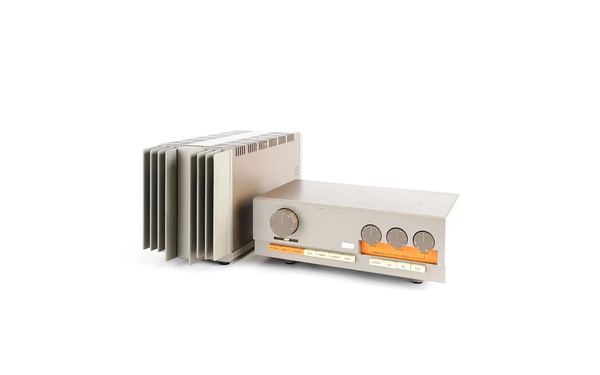
Up to now, on this site, the amplifier has always been a single box: the NAD 3020 has the pre, the power stage and even the phono all inside one unit. The Quad 33 and 303 are a different thing, and it is the reason this guide exists: they are two separate units, a preamplifier and a power amp, that you buy together and connect to each other. It is the first separates on our path, and it is worth explaining what changes before saying why they are a classic. As with the NAD, the Thorens and the Technics, I speak as a buyer, not a technician, and the general method for judging used gear is in our restoration hub. Here is only what concerns this pair: one of the most iconic British hi-fi systems ever made, and the simplest way into the world of separates.
Separates: two boxes instead of one
An integrated like the NAD 3020 does everything in one chassis: convenient, compact, a single decision. A separates system splits the work in two — the preamplifier selects the source, handles the volume and the controls, and sends the signal to the power amplifier, which amplifies it and drives the speakers.
What it means in practice, honestly: one more signal cable between the two boxes, a larger footprint, and — in the case of the vintage Quad — a detail we will explain, the DIN connections. The advantage, in return, is real and long-term: you can replace one piece at a time. A more powerful amp tomorrow, or a better pre, without throwing the whole amplifier away. It is the logic that shaped the history of hi-fi, and the Quad 33/303 is the cheapest and most iconic way to meet it.
The preamplifier: the Quad 33
The 33 is the control centre: launched in 1967, recognisable anywhere for its grey with the orange accents. It has four inputs — "disc" for the turntable, two "radio" and "tape" — and all the original connectivity is DIN, not RCA: a period detail that, when connecting a turntable or modern sources, may need adapters.
On the phono, a common misconception must be cleared up, because it matters to vinyl listeners. The 33's phono stage is RIAA — the equalisation standard still used today — so it works with modern records without trouble. What the 33 offers on top is not curves for different recording standards, but two things: plug-in "Disc Adaptor" modules to match different cartridges, and a filter system — at 5, 7 and 10 kHz, with a "slope" control — meant to soften the surface noise and the hardness of the pressings and broadcasts of the era. With a clean record, today, those filters are left out and the 33 behaves like an ordinary RIAA phono stage.
The power amplifier: the Quad 303
The 303 does the heavy lifting. Also launched in 1967 as Quad's first solid-state power amp, it delivers about 45 watts per channel into 8 ohms — no monster of power, but the quality of the watts counts more than the quantity with the right speakers. Its heart is the "triples" output stage devised by Peter Walker, which gives it thermal stability and low distortion, and a character of smooth, transparent midrange that is the Quad signature.
Born to drive the company's electrostatic speakers, the 303 is not built for deep bass or high volumes in a large room: it gives its best on voice, jazz and chamber music, at sensible levels. It is compact, reliable, and among the best-selling power amps in history — an estimated hundred thousand or so were made. It is why so many are still around, and why spares are not a problem.
How to find and buy them together
On the used market the 33 and the 303 are found sometimes as a pair, often separately: many sell them singly, so you may have to hunt them one at a time and reunite them. It is not a problem — they were born to go together, and any 33 drives any 303 — but it is useful to know before starting the search.
What to check, all observable without technical knowledge:
- The service. These are machines nearly sixty years old: the original capacitors, by now, almost always need replacing. An unserviced 33/303 can hum, have unbalanced channels or noisy controls. Buy a pair already sorted with receipts, or budget for the service — the same rule as the Thorens and the NAD. - The DINs. Remember the DIN-to-RCA adapters to connect them to a turntable and modern sources: factor them in. - The state of the controls. Move the volume, balance and filters: if they crackle or jump, they need cleaning or a service. - The pair. If you buy the two pieces separately, that is fine — just check that both have been (or will be) serviced, because a sound pre with a tired power amp sounds bad anyway.
The Quad 33/303 is the classic to hunt for anyone who wants to meet separates without spending a fortune: a pre and a power amp, two boxes to connect, the most iconic and affordable way to leave the integrated behind. It is the opposite of the NAD 3020 — where that one puts everything in one chassis, this one splits the work and opens the door to future upgrades, one piece at a time. In return it asks for one more cable, the DIN adapters and, almost always, a service: these are machines nearly sixty years old. The 33 has a RIAA phono with filters to tame noisy records, the 303 makes 45 transparent watts born for voice, jazz and chamber music, not for high volumes. Hunt them with patience, even separately, and buy them serviced: it is a piece of hi-fi history that still plays today.
Affiliate link — no extra cost to you · How we review →
Why a separate pre and power amp instead of an integrated?
For two reasons: the transparent character of the Quad pair, and the ability to upgrade one piece at a time in future — a more powerful amp or a better pre without changing everything. The downside is practical: one more signal cable, a larger footprint, and the period DIN connections that may need adapters.
Were the Quad 33 and 303 born together?
Yes, both in 1967, as Quad's first solid-state pre and power amp, designed to work as a pair. They stayed in production for a long time, with slightly different end dates: the 33 into the early 1980s, the 303 into the middle of the decade.
Is the 33's phono fine with today's records?
Yes: the 33's phono stage is RIAA, the standard still in use, so it reads modern records without trouble. The 5, 7 and 10 kHz filters it offers are not curves for other standards, but serve to soften the noise and hardness of poor pressings; with a clean record they are left out.
Do I have to buy them together?
No: on the used market they are often found separately, and any 33 drives any 303. You can hunt them one at a time and reunite them. What matters is that both are serviced: a sound pre paired with a tired power amp still sounds bad.