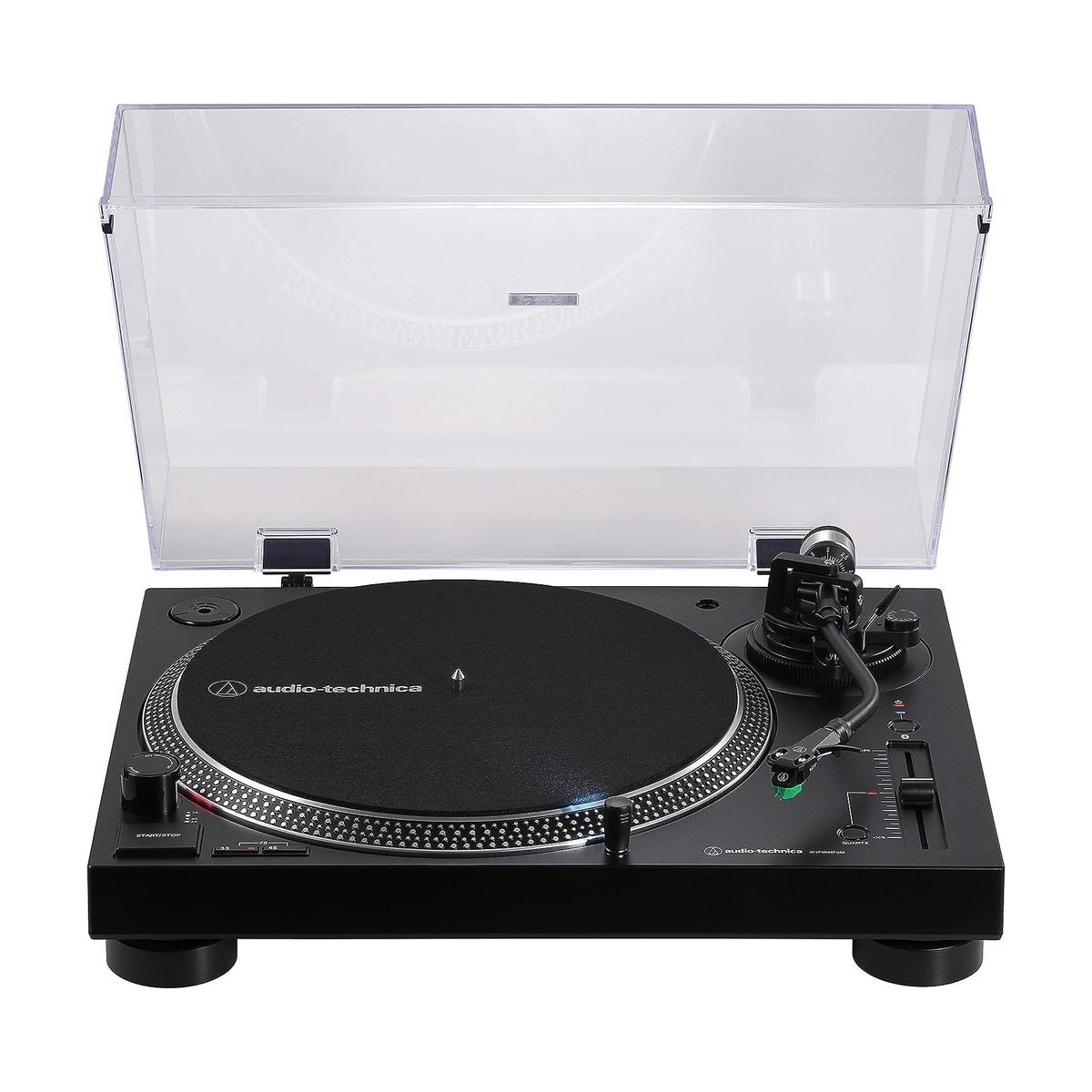
The AT-LP120XUSB is the odd one out of the ranking, and by design. Where the others are pure belt-drive listening decks, this is the Swiss army knife: direct drive, a USB output to digitise your records, pitch control, a phono stage already inside and a cartridge already fitted. It is the deck that does the most of any here. The review's question is whether "does the most" is what you want.
Context
Audio-Technica has designed cartridges since 1962, and the LP120X carries the mark of its DJ lineage — direct drive, S-shaped arm, pitch, strobe — adapted for the living room. It is the update of the well-known AT-LP120-USB, with a new DC-servo direct-drive motor, adjustable dynamic anti-skate and a switchable phono stage. It ships with the AT-VM95E, the cartridge we have reviewed separately.
Design & build
It is a heavy machine: eight kilos, a die-cast aluminium platter, a metal plinth. Physically it is the most solid of the entry turntables we have analysed, built like a tool rather than an ornament. The S-shaped arm has a detachable AT-HS6 headshell — swap cartridges in seconds — and a hydraulically damped lift.
The stroboscopic platter with its speed indicator and the plug-in stylus target light give away the console heritage. External power supply, hinged dust cover. It is not as elegant as the Pro-Ject: it is functional, and it owns that.
What reviewers say
The sound character on this page does not come from our own listening: we report it from published reviews, with the name of the person who wrote them.
Louder (James Grimshaw, March 2026, an updated version of a review first written in 2021 by Paul Dimery) describes a deck as solid in its sound as in its build: a full, vivid presentation even through the internal phono stage, defined bass where cheaper decks tend to smear, treble with some urgency and very stable speed. The limits: a constant whistle on USB recordings, a tracking force that needs setting with a stylus gauge, and a cueing lift that is not very smooth.
Trusted Reviews (Simon Lucas, August 2019) reports an incisive, warm sound with good timing: bright treble without hardness, nuanced mids, a convincing soundstage, dynamics well handled and excellent speed stability. The bass is rich but not very firm: the kick drum sounds a little deflated and at times drags. The internal phono stage is decent but falls short of a Rega Fono Mini A2D, USB rips lose drive and timing, and the build uses more plastic than a Technics. At a similar price, it concludes, the Rega Planar 1 sounds better.
Vinyl performance
The detachable headshell and the adjustable counterweight and anti-skate make it a genuine platform: change cartridge whenever you like, upgrade the VM95E's stylus up to microlinear on the same body, play 78s. It is the deck that digests whatever you put on it.
And it does one thing no other deck in the ranking does: with the USB output you digitise records into files on a computer. For anyone with vinyl that does not exist in digital — or who just wants it on headphones — that feature alone earns the price of admission.
Value & competition
It is the only direct-drive deck in the ranking, against two belt-drives already in our files, and it is worth saying what really changes. Direct drive gives nailed-on speed and DJ use; USB digitises; pitch tunes or mixes; and the switchable phono stage does something hugely practical — it connects to any amplifier, with or without a phono input, or to powered speakers.
Against the Rega Planar 1: according to Trusted Reviews the Rega sounds better at a similar price, but it has no USB, no pitch, no 78 RPM, and it wants a phono downstream. Against the Pro-Ject T1: both have a phono stage and connect straight away, but the LP120X adds direct drive, USB, pitch, 78 RPM and cartridge upgradability, while the T1 is simpler. In a line: the LP120X is the deck for anyone who wants to do everything — listen, digitise, mix, play 78s — from a single box.
In the vinyl chain
Thanks to the switchable phono stage it really does connect to anything: an amp with or without a phono input, or active speakers. To digitise, connect the USB output to a computer and use free software such as Audacity.
A note for US readers: in the United States Audio-Technica sells the AT-LP120XBT-USB version with Bluetooth, and the non-BT model is no longer on amazon.com — which is why the US link on this page goes to the used market. It is a distribution choice, not a shortcoming of the deck. Natural upgrade: the AT-VMN95ML (microlinear) stylus on the same cartridge.
- Direct drive: nailed-on speed, plus 78 RPM and DJ use
- Switchable built-in phono stage: connects to any amp, with or without a phono input
- USB output to digitise records; AT-VM95E cartridge included and upgradeable
- The most complete deck in the ranking, heavy tool-grade build
- According to Trusted Reviews the Rega Planar 1 sounds better at a similar price
- Modest quoted phono signal-to-noise
- In the US it is sold new only in the Bluetooth version; the non-BT model is on the used market
- Console looks and layout rather than minimalist living-room style
Phono stage: not needed, it is built in and switchable. Amp: any, even without a phono input. To digitise: a computer with Audacity over USB. Speakers: Wharfedale Diamond 12.1i or Q Acoustics 3030i. Upgrade: the AT-VMN95ML (microlinear) stylus on the supplied VM95E.
Verdict
Buy the AT-LP120XUSB if you want the most versatile deck in the ranking: a single box that plays, digitises, mixes and connects to any system. It is also the most complete and one of the most solid, and for features per pound nothing here comes close.
On pure sound, Trusted Reviews gives the edge to the belt-drive Rega Planar 1 at a similar price. But if your idea of a turntable includes the computer, 78s or the console, this is the right one — and nothing else in the class gets near it on features.

