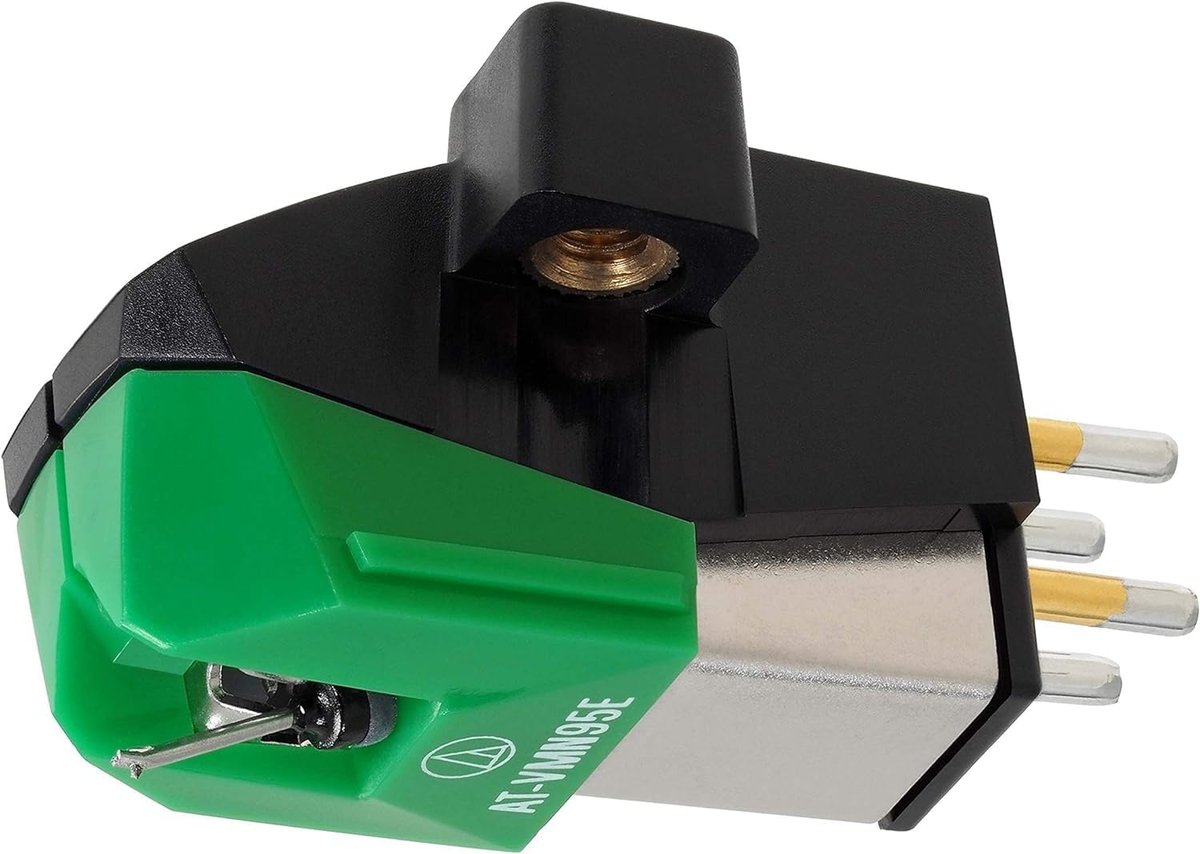
The VM95E is the cartridge most people meet as their first upgrade: the one that replaces the stock stylus on a budget deck, or a worn-out cartridge on a vintage machine. It costs a little over forty pounds and is usually dismissed with an empty line about value for money.
The point lies elsewhere, and it is structural. You are not buying a cartridge, you are buying entry into a family. The VM95 body stays where it is for years; the only thing that changes, when you decide, is the stylus.
Context
Audio-Technica built the VM95 series to replace the AT95E, one of the biggest-selling cartridges of recent decades. The design is dual magnet — hence VM — with a redesigned coil that lifts output to 4.0 mV.
The underlying decision, though, is one of system. Audio-Technica states that every model in the VM95 series shares the same body, and that the stylus can therefore be swapped for any of the six AT-VMN95 replacements. It is the same modular logic as Ortofon's 2M series, starting from considerably further down.
Design & build
The housing is low-resonance polymer with threaded inserts already fitted: it mounts with two screws and no nuts, which makes installation close to beginner-proof. The cantilever is an aluminium pipe, the stylus a 0.3×0.7 mil bonded elliptical — the diamond glued to a shank rather than nude. Weight 6.1 grams, standard half-inch mount.
One warning worth the price of the cartridge: styli from the older AT95E are not compatible with the VM95 body, and vice versa. They are two different families with similar names, and it is the commonest purchasing mistake on this model.
What reviewers say
The sound character on this page does not come from our own listening: we report it from published reviews, with the name of the person who wrote them.
StereoNET (David Price, May 2020) describes it as lively, with open, clean mids, dry bass, detailed treble and a wide soundstage; against the old AT95E he finds it less veiled and more nuanced. The limits: it is a touch bright up top, and the kick drum and bass lack weight.
hifi.de (Bernhard Rietschel, December 2022, a German site) finds it neutral, with smooth, fine treble, less grainy than the AT95E's, and generous spaciousness. It points out that the balance depends on the phono stage's load capacitance: balanced at around 150 pF, darker with less capacitance and brighter with more. The limits: alignment is trickier, and anyone coming from the AT95E may miss its drive.
The two reviews disagree on the treble balance: a touch bright for StereoNET, smooth for hifi.de.
Vinyl performance
Here is the figure that generic product pages never give you. Quoted dynamic compliance is 7 × 10⁻⁶ cm/dyne at 100 Hz, which translated to the frequency that matters for the calculation works out at roughly 12 units: this is a low-compliance cartridge, and it therefore belongs on medium- to high-mass tonearms.
That is why it turns up in the £800 system paired with the original TP16 arm on the Thorens TD 160, which weighs around sixteen and a half grams: together they put the resonance inside the useful window. On the lighter TP16 of the later versions, the same cartridge falls outside it. The rule governing all of this is set out in the listening chains hub, and there is no point repeating it here.
Value & competition
You climb the family by changing only the tip, and the steps are measurable rather than merely described. From the E's bonded elliptical you move to the EN's nude elliptical, which widens the response and improves separation; then to the ML's microlinear, which takes response to 25 kHz and separation to 23 dB; and finally to the SH's Shibata. Same body, performance from another class.
Against the direct rivals: the Ortofon 2M Red is more universal and costs about twice as much; the other is the Nagaoka MP-110. The VM95E is the cheapest of the three and has the longest upgrade ladder. We have not found a direct listening comparison between these cartridges in published reviews: hifi.de notes only, on the technical side, that VM cartridges cope better than the higher-output 2Ms with a somewhat high load capacitance. The full comparison with the Ortofon sits in the head-to-head between them.
In the vinyl chain
It wants an ordinary MM phono stage with a 47 kΩ load and 100 to 200 pF of capacitance: any built-in phono input or budget preamp will do, and the 4.0 mV output troubles nothing downstream.
Upstream, the real constraint is the arm: medium or high mass. On vintage Japanese arms and early Thorens decks it is at home; on a very light arm it is not. Set the tracking force to 2.0 grams, the quoted standard, and leave it there.
- Six interchangeable styli on one body: climb to microlinear or Shibata without changing cartridge
- Generous 4.0 mV output: happy with any MM phono stage
- Low compliance: one of the few right matches for medium- and high-mass vintage arms
- Mounts with two screws and threaded inserts, no nuts
- A touch bright up top and light in the bass according to StereoNET (hifi.de finds the treble smooth instead)
- The wrong choice on light arms: resonance falls outside the useful window
- Older AT95E styli are not compatible: the commonest purchasing mistake
Arm: medium or high mass — the constraint that decides everything. Phono: any MM stage with a 47 kΩ load and 100-200 pF capacitance. VTF: 2.0 g, the quoted standard. Natural upgrade: the AT-VMN95ML microlinear stylus when you want the real step up, on the same body. Note: make sure you buy a VMN95-series stylus, not one from the older AT95 series.
Verdict
Buy it if your arm is medium or high mass and you want the cheapest route to a real step up from a stock stylus. Buy it above all if you expect to keep that turntable a long time: a year or two from now you can fit a microlinear without replacing anything else.
Skip it if you have a light arm: other choices serve better there. This is a cartridge with a ladder behind it.

