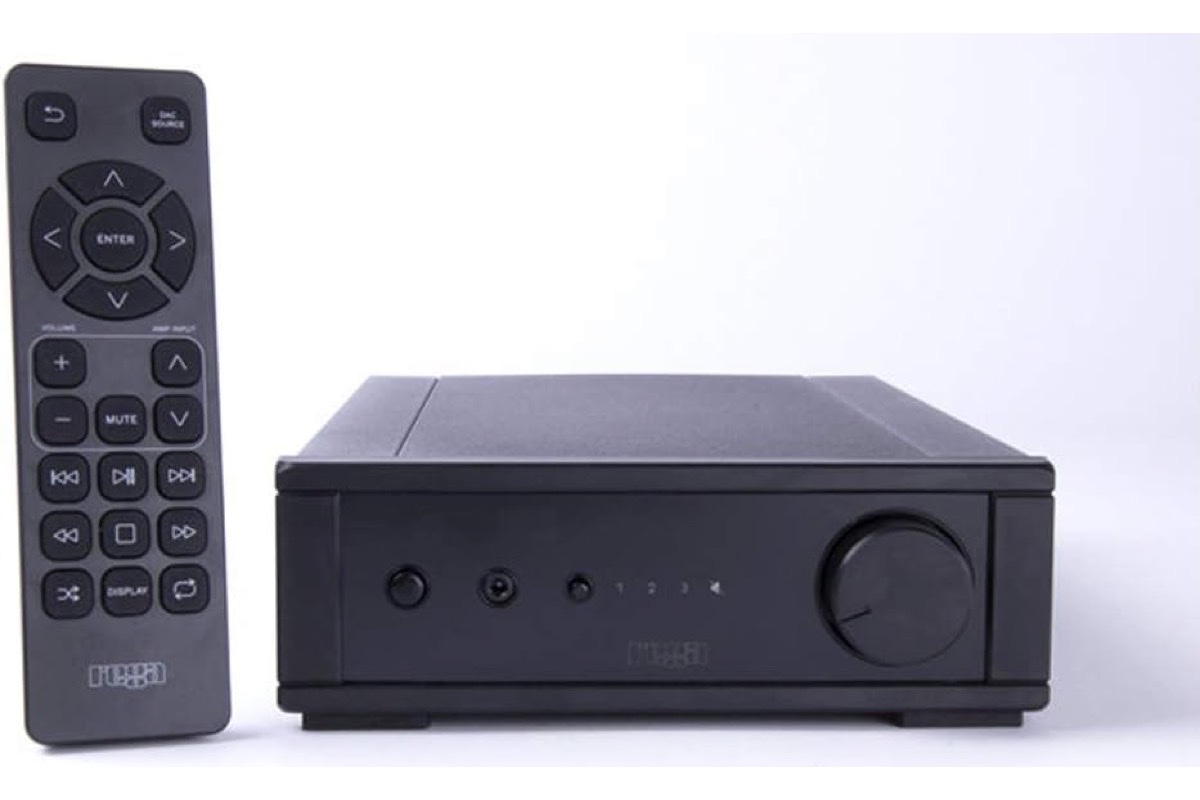
The Rega io is the amplifier for those who have already decided that vinyl comes first. It has no DAC, no Bluetooth, no digital input: it has two line inputs, an excellent phono stage and thirty watts done well. It is deliberately essential, and in that choice lies all its intelligence — you do not pay for functions you would not use, you pay for the sound.
It is our number one among entry integrated amps, and it is worth clarifying at once which Rega this is: it is the io, the company's entry integrated, not the Brio nor the Elex, which sit a step above for power and features. The io's trick is that, though it costs less, it inherits from the Brio the two things that matter — the power amp and the phono stage.
Context
Rega is a long-established British maker, born around turntables and with a precise philosophy: put the money where you can hear it, in the circuit, not in the surrounding functions. The io arrived in 2020 as a "smaller Brio": it takes the award-winning Brio's Class A/B power stage and its linear power supply, scales it to deliver 30 watts instead of 50, and puts it in a compact case.
In our ranking of entry integrated amps it takes first place, and the reason is consistent with the soul of the site: it is the most musical amp in the class, the one made for those who mostly listen to records. The others offer more watts and more sockets; the io offers the sound.
Design & build
It is a small machine — 18 cm wide, under three kilos — with an aluminium shell and a heavy metal base that helps shed heat. The build is solid and careful in the Rega tradition; the one criticism is aesthetic, the glossy plastic front panel that does not shout "premium". But it is a declared choice: Rega has put the money in the circuit, not the face.
Inside, the substance is the Brio's: Sanken output transistors, an Alps volume potentiometer of a quality above the class, a linear power supply. The headphone output is driven directly from the power amp via relays — so it genuinely sounds good, it is not an afterthought — and inserting the jack mutes the speakers automatically. The remote is included. The one practical limit: being narrow, the rear sockets sit close together, and with thick cables the connection is a little awkward.
Sound analysis
Here the io does what it was born for, and it is the reason for first place. The sound is the Rega signature: rhythm, timing and musicality above all. On a track with drive — a soul cut, a piece of jazz with push — the io holds the timing with a contagious energy, the kind that makes you want to play another record, and another. The press treats it as a class reference for exactly this: it is not the most powerful, it is the most involving.
It is not an analytical or cold amp: it lets the music flow naturally, without obvious colouration, and it is even forgiving of imperfect recordings — a virtue worth gold at this price. The thirty watts look modest on paper, but with speakers of normal sensitivity they are more than enough for high volumes in a real room. The limit is with very demanding speakers or large rooms: there you would want the Brio.
Vinyl performance
This is the heart of the review, because it is the heart of the io. The built-in MM phono stage is the same circuit as the Brio's — not a reduced version, the same — set to 220 pF, with plenty of gain for any moving-magnet cartridge. In practice: you connect the turntable directly to the io, without buying a separate phono stage, and you get a phono of real quality, not the usual thrown-in built-in stage.
This is where the io really saves you money. An amp without a phono stage forces you to add a preamp — even a good one, like the iFi ZEN Air Phono 2 — and on the io you do not make that spend: it is already inside, and it is of real quality. For those who mostly listen to vinyl, this changes the total cost of the system, and moves the io ahead of rivals that look richer on paper. The limit, consistent with the philosophy, is that the phono is MM only: with a moving coil you need an external MC preamp.
Value & competition
In the Rega range, the io sits below the Brio (50 W, more inputs) and the Elex (more power and features still): if you have demanding speakers, a large room or want more sources, the step up is toward those. But for most people entering hi-fi with vinyl in mind, the io is more than enough — and the price difference is better spent elsewhere in the chain.
Against the rivals in our ranking, the positioning is clear. The closest comparison is the Marantz PM6007, which sits a whisker above in the composite score: it sounds superb and adds a DAC with digital inputs, but it costs a third more, and that premium buys features rather than vinyl musicality. If the turntable is your main source, the io puts the same money where you hear it; if you also need digital, the Marantz is its natural senior. Amps like the Yamaha or the Cambridge offer more power and digital inputs — a DAC, sometimes streaming — and are more versatile if you also listen from digital sources; the NAD adds Bluetooth and a hybrid soul. They are excellent for those who want a do-everything system hub. The io does the opposite: it gives up digital and bets everything on analogue musicality and a phono stage done well. It is the purist of the class — and it is why, for the vinyl-first listener, it is our first. It is not the amp with the most functions: it is the one that plays records best.
In the vinyl chain
The io is the natural centre of a vinyl-first chain: a turntable in the phono input, easy-to-drive speakers on the output, and optionally a line source in one of the two RCAs. With 30 watts, the pairing must be judged on speaker sensitivity: efficient, easy speakers like the Triangle Borea BR03 (90 dB) are ideal partners, while thirsty or low-sensitivity speakers would call for the Brio.
In our bookshelf-speaker ranking you will find several suitable pairings. It is also the amp we cite when a chain built piece by piece needs an integrated with the phono already inside — the idea of the £800 system: turntable, io, speakers, and you are set without an added phono stage.
- Reference musicality and rhythm in the class: the sound is its reason for being
- MM phono stage identical to the Brio's: a real phono already included
- No spend on digital you would not use: essential by choice
- Excellent headphone output from the power amp, remote included, lifetime warranty
- Only 30 W: with demanding speakers or large rooms you need the Brio
- No digital input: no DAC, no Bluetooth, no USB
- MM-only phono: with a moving coil you need an external MC preamp
- Plastic front panel and closely spaced rear sockets (awkward with thick cables)
Speakers: easy-to-drive speakers of good sensitivity (the Triangle Borea BR03 at 90 dB is ideal); avoid thirsty or low-sensitivity ones. Turntable: any, with an MM cartridge, into the phono input. Sources: up to two line-level (CD, streamer) on the RCAs. Room: small or medium — for high volumes in large spaces, step up to the Brio.
Verdict
Buy the Rega io if vinyl is your main source and you want the most musical sound in the class, with a real phono stage already inside and no spend on digital functions you would not use. It is essential by choice, not by economy, and it puts the money where you can hear it. It is our number one among entry integrated amps, and it is so for one reason, but a decisive one: how it makes records sound.
It is not for you if you want a system hub with a DAC and Bluetooth (look at the Yamaha or the NAD), if you have very demanding speakers or a large room (step up to the Brio), or if you mostly listen from digital sources. But for the vinyl-first listener — few inputs, no frills, the phono done well — there is nothing in this class that beats it on its own ground.

