Thorens TD 160
The Icons 02 — a sprung sub-chassis and a tonearm with two souls
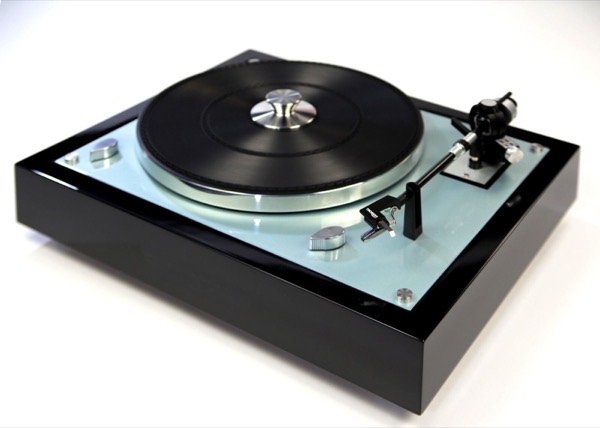
You find one for sale at a little over two hundred euros: the wooden plinth, the heavy platter, that sprung suspension that made Thorens's name. And you wonder whether it is the bargain it looks like or the wrong version you will only discover at home. Because with the TD 160 — and this is the point of the whole guide — the version matters more than the model. Let me answer from where I can: I am not a technician, and this is the reasoning of a buyer, not a repairer. The general method for judging a vintage component — what ages, what to ask, how to do the sum — lives in our restoration hub, and there is no point repeating it. Here is only what applies to this turntable, and above all the thing to know before answering any advert: which tonearm you are bringing home.
Why it is a classic
The TD 160 arrived in 1972, successor to the TD 150, and it brought with it what makes the Thorens decks of that era special: the three-spring floating sub-chassis, which isolates the platter and arm from the vibration of the furniture and the floor. Below sits a 16-pole synchronous motor with belt drive; above, an alloy platter of over three kilos. It is the same mechanical base as the far dearer TD 125 and 126.
But the reason the collector hunts it down is the tonearm. The TP16 shares its layout and geometry with Thorens models from well above its class: it was a serious arm in its day, and it still is. That is the sense of the TD 160 — the construction and the arm of an expensive deck, at a price that today, used, is entry-level.
The heart of the guide: the two TP16 masses
Here is the point that decides the purchase, and the reason this guide exists. The TP16 is not one arm: it exists in two very different masses, and the difference changes which cartridges you can fit.
The original TP16, on the early TD 160s, has an effective mass of around 16.5 grams — a heavy arm. From 1976, with the MkII "Isotrack" version, the mass drops to around 7.5 grams — a light arm. (The TD 160 Super carries the TP16 MkIII.)
Why does it matter? Because arm mass, together with cartridge compliance, sets the system's resonance frequency, which needs to fall between 8 and 12 Hz — the rule set out in our listening chains hub. In practice: the heavy arm (16.5 g) wants low-compliance cartridges — a Nagaoka, an Audio-Technica VM95E, the old Grados or Stantons; the light arm (7.5 g) wants compliant cartridges, like an Ortofon 2M or OM. Fitting the wrong cartridge to the wrong arm is the surest way to make a good turntable sound bad. That is why knowing which TP16 you are buying is not a detail: it decides the cartridge, and so the sound.
How to identify the version before buying
The good news is that the two versions can be told apart by eye, in a photograph, without opening anything. Ask the seller for two images — the plinth and the arm — and you know what you are buying.
First clue, the simplest: Thorens labelled them. If the plinth says "Mk II", it is the second series, the one with the light 7.5 g arm. If it says only "TD160", with no suffix, it is the first series, with the heavy 16.5 g arm.
Second clue, the arm itself. The original TP16 has a separate detachable headshell — the square TP60 that plugs into the end. The TP16 MkII "Isotrack" has no separate headshell: the whole wand detaches instead (the TP62 system). So, looking at a photo of the arm: a separate square headshell = the heavy version; a detachable wand with no distinct headshell = the light version.
With these two checks — the label on the plinth and the arm's connection type — you need nothing else to know which of the two masses is coming. Do them before buying, not after: changing your mind about the cartridge once you have the wrong arm costs twice.
The variants
Besides the original TD 160 and the MkII, the family includes the TD 160 Super (a different plinth, a damped motor plate, the TP16 MkIII) and the rare TD 160 BC, sold without an arm and with a blank armboard, for those who wanted to fit an SME or another arm. Not to be confused with the cheaper sibling, the TD 165, which uses the TP11 arm instead of the TP16.
Used, you will find them all, sometimes mixed up in the listings: B, MkII and Super are the same family, not different machines to avoid — but each has its own arm, and the rule above always applies. The TD 160 BC in particular has no standard TP16: whatever is on it was fitted by someone, and must be judged separately.
What to check before buying
The general questions — has it been serviced, when, by whom, are there receipts — are in the hub. On this turntable, add these checks, all observable without technical knowledge:
- The suspension. The sub-chassis must move freely: press gently on the platter and it should bounce up and down cleanly and vertically, without swaying sideways or scraping. A seized or unbalanced suspension is the typical fault of a poorly kept example, and it is the first thing to look at. - The belt. If the speed is unstable or the platter starts slowly, the belt is probably old: a common replacement, but useful to know when haggling. - The motor hum. On the original, now-aged capacitors, the motor can vibrate and hum even at rest. It is a signal to listen for. - The arm. Check that the cue lowers smoothly and that the arm turns freely on its bearings. The tracking-force adjustment is a spring in a small tube over the pivot: make sure it responds. - The cabinet and lid. The slide-on lid hinges loosen or break, and the veneered particle-board plinth dislikes damp. Look at the overall condition, which tells you how it was kept.
These are observations, not diagnoses. But a TD 160 that passes them is in a different category from a house-clearance one.
What to expect to pay
In bands, not hard figures. A working TD 160 sits, on the used market, between two hundred and fifty and four hundred euros — the upper end for serviced examples, with a new belt and the suspension set up. Below that there is usually work to do, and then the service has to be added to the price, which on a suspended turntable is not trivial: setting up the suspension, the belt, often the motor capacitors.
The full sum — price plus work — is the one to do before falling in love, and it is set out in the restoration hub. And budget for a new cartridge: the fitted one is almost always an unknown, and you already know it has to be chosen for the arm's mass.
The TD 160 is the classic to hunt for anyone who wants a sprung sub-chassis and a serious arm at an entry price, with one warning worth more than any other: the version matters more than the model. Before buying, establish which TP16 is coming, because it decides the cartridge and so the sound — look at the label on the plinth ('Mk II' = the light 7.5 g arm; just 'TD160' = the heavy 16.5 g one) and at the arm (a separate square headshell = heavy; a detachable wand = light). Then check the suspension, the belt and the motor hum, and budget for a belt, a service and a cartridge chosen for the right mass. Do that, and you bring home a mechanism that once cost a great deal more — and can still prove it.
Affiliate link — no extra cost to you · How we review →
Which version of the Thorens TD 160 should I look for?
It depends on the cartridge you want to use. The heavy early arm (16.5 g) suits low-compliance cartridges; the light arm from the MkII (7.5 g) suits compliant ones. More than the suffix, though, what matters is the condition of the example and whether it has a documented service.
How do I know which TP16 arm it has?
From two things visible in a photo: the label on the plinth (if it says 'Mk II' it is the light 7.5 g arm; if it says only 'TD160' it is the heavy 16.5 g one) and the connection type (a separate square headshell = heavy; a detachable wand with no headshell = light). Always ask for photos before buying.
Can I fit any cartridge?
No: the cartridge has to be chosen for the arm's mass, so that the resonance falls between 8 and 12 Hz. The heavy arm needs low-compliance cartridges, the light arm compliant ones. It is the rule set out in the listening chains hub.
A vintage TD 160 or a new entry-level turntable?
The TD 160 if you want a sprung sub-chassis and a serious arm, and you have a technician within reach for the setup. A new turntable if you want plug-and-play with no surprises. The comparison is in our ranking of entry-level turntables.