Hamburg and its record shops
On 22 June 1961, in a hall at Hamburg's Friedrich-Ebert-Halle, five unknown boys from Liverpool recorded their first song for a record label. The label didn't call them the Beatles — too close to a coarse piece of German slang, Polydor decided — but "the Beat Brothers." That single, hunted under the wrong name for six decades by people who don't know any better, is still the most hidden-in-plain-sight record in Germany.

Start here, because it explains everything else: why Hamburg, not Liverpool, is where the Beatles actually became the Beatles; why the same city named an entire genre — Krautrock — a decade later; why another twenty years on it produced the German-language indie scene that changed national pop music; and why, right now, the same handful of streets around the port still produce house and techno that reach all the way to Berlin.
St. Pauli has been a red-light entertainment district since the Middle Ages, built deliberately outside the old city walls so that respectable Hamburg wouldn't have to look at what its port required: bars for sailors, brothels, burlesque halls, cheap all-night entertainment for men who'd just come off a ship with money to spend before the next one left. When rock and roll reached West Germany in the mid-1950s, it didn't need to charm its way in — it needed a district already built for entertaining an international, transient crowd all night, and St. Pauli was exactly that. Rock and roll simply moved in.
The man running the venues that mattered, Bruno Koschmider, had a simple, brutal business model: keep customers drinking as long as possible, which meant keeping bands on stage for hours, night after night, shouting "mach Schau" — make a show, do something, don't just stand there. That single instruction, repeated for months, is what actually turned five unknown Liverpool boys into a live-music machine — not inspiration, a business model that demanded thousands of hours of stage time.
The dates trace a trail still walkable through the district today: 48 nights at the Indra (Große Freiheit 64) from 17 August 1960, then 58 at the bigger Kaiserkeller (Große Freiheit 36) — where they meet a drummer called Ringo Starr, on loan from another Liverpool band. In November 1960 George Harrison is deported for working underage; days later McCartney and Best spend a night in a cell over a small fire in their squalid room behind the Bambi Kino's cinema screen. They return in 1961 for 92 concerts at the Top Ten Club, where bassist and painter Stuart Sutcliffe — engaged to Hamburg photographer Astrid Kirchherr — lands a real punch on McCartney onstage after a cruel remark. Sutcliffe leaves the band soon after to stay in Hamburg and study art; he dies here on 10 April 1962, aged 21. In April 1962 the Star-Club opens, with the Beatles booked for its first seven weeks — the last of five residencies that finally turn them into a band that can hold any stage on earth.
Almost none of it survives physically as it was: the Kaiserkeller is now the basement of the club Große Freiheit 36, still active; the Indra has been rebuilt and reopened as a music venue; the Star-Club burned down in 1987, leaving only a plaque inside a small shopping arcade; the Bambi Kino is marked by a small model deer. Beatles-Platz, at the corner of Reeperbahn and Große Freiheit, holds five life-size steel silhouettes on a black, vinyl-shaped plaza. The city's one Beatles museum, Beatlemania Hamburg, closed for good in 2012 for lack of visitors: there is no Beatles museum in Hamburg today.
The port didn't stop working after 1962 — it just changed cargo. In 1969, in a Hamburg air-raid bunker, a band called Faust formed; in 1973, a track simply titled "Krautrock" on their album Faust IV gave the entire genre its name (even though the landmark debut itself was recorded out of town, at Wümme). Twenty years later the same city produced the Hamburger Schule: Blumfeld, Tocotronic, Die Sterne, serious German-language indie rock, with Blumfeld's 1992 Ich-Maschine generally treated as its founding record. And since the 2000s the same port has been importing house and techno from Detroit and Chicago through the same cosmopolitan channels that once carried rock and roll to St. Pauli's stages — Diynamic, Smallville Records, the Golden Pudel Club on the Fischmarkt.
What follows from that history: Hamburg is a spread-out city, not a compact one like Amsterdam or Paris — you'll use the U-Bahn and S-Bahn between clusters, not just your legs. The dense pocket is St. Pauli/Karoviertel; elsewhere the city offers deep specialists rather than generalist warehouses. Prices are honest, English is spoken everywhere, and cash still helps in a handful of smaller shops. Sunday, which kills shopping everywhere else in Europe too, gives Hamburg something no other chapter in this series can offer in exchange: the Fischmarkt, open from five in the morning.
St. Pauli: from Beatles-Platz to the Karoviertel
The absolute heart of vinyl Hamburg: eight shops within a twenty-minute walk, threaded through the same streets that carried the Beatles from the Indra to the Kaiserkeller to the Star-Club.
Zardoz Records (Marktstraße 55, U3 Feldstraße, Mon–Fri 12–6pm, Sat 11am–6pm) has been the city's reference generalist for over thirty years — every genre, new and used, with a knack for pricing rare finds fairly. Groove City Recordstore (Marktstraße 114, same stop, Mon–Fri 12–7pm, Sat 11am–6pm), founded in 1992 and run since 2005 by Marga Glanz and Anja Knupper, is the rap, hip-hop, soul, jazz and African-music specialist, with flea-market boxes of used stock out front at decades-old prices. Hanseplatte (Neuer Kamp 32, Mon–Sat 12–6pm) states its mission plainly: local Hamburg music, from new releases back to early Hamburger Schule pressings — and it occupies, not coincidentally, the same address as the now-closed house-and-techno shop Smallville Records.
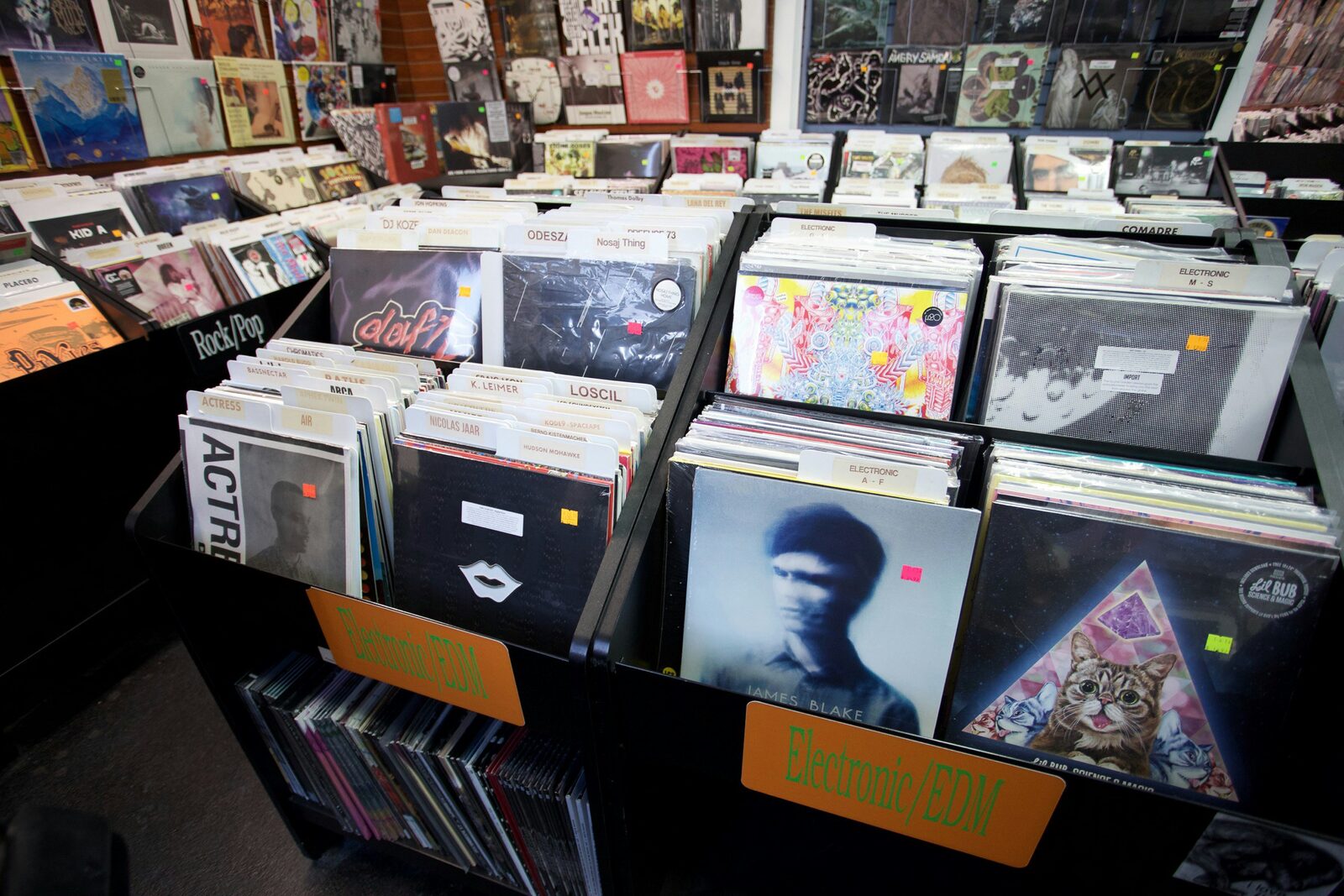
Otaku Records (Bleicherstraße 3, S-Bahn Reeperbahn, Tue–Fri 2–7:30pm, Sat 1–6:30pm) has been the city's electronic-only temple since 1997 — ambient, techno, house, drum'n'bass, disco edits, on every format. Freiheit & Roosen (Kleine Freiheit 80, U3 St. Pauli) is the city's great secondhand warehouse, crates stacked to the ceiling — brilliant for unstructured digging. Rounding things out: Lemme Know (Seilerstraße 24, the newest shop), Minigroove (Simon-von-Utrecht-Straße 17) and Back Records (Wohlwillstraße), both small neighbourhood secondhand shops.
Altstadt / Neustadt: the old town
Michelle Records (Gertrudenkirchhof 10, U3 Mönckebergstraße, Mon–Fri 11am–8pm, Sat 11am–7pm) is Hamburg's oldest shop, trading since 1977 — winner of Germany's Echo music prize in 2014, famous for in-store "shop-window concerts" that have hosted Calexico, Yo La Tengo and the Go-Betweens. "From jazz to Krautrock," with real pride in stocking Hamburg's own labels. A short walk away, Pure Soul Recordshop (Kohlhöfen 17, Tue–Sat 12–6pm) is a small shop of hand-picked original pressings — more than one reviewer calls it the best soul shop in the country.
Grindelviertel, Eppendorf, Eimsbüttel
Three zones, three single-destination specialists — but the kind worth the trip. Plattenrille (Grindelhof 29, U1 Hallerstraße, Mon–Fri 12–7pm, Sat 11am–6pm), over 40 years of specialist secondhand, is repeatedly named by locals as the city's best shop. Ju-Ju Trumpet (Erikastraße 50a, U1/U3 Kellinghusenstraße, Tue–Fri 11:30am–6:30pm, Sat 10am–2:30pm) is the absolute jazz specialist, run by Michael Grüßing since 2018. Plattenkiste (Gärtnerstraße 16) covers the full rock-and-metal spectrum, right next to a hi-fi shop on the same street.
| Shop | Zone | Specialty |
|---|---|---|
| Michelle Records | Altstadt | The institution since 1977, every genre |
| Zardoz Records | St. Pauli/Karoviertel | 30-year generalist |
| Otaku Records | St. Pauli | Electronic only since 1997 |
| Groove City | St. Pauli/Karoviertel | Rap, soul, jazz, African music |
| Hanseplatte | St. Pauli/Karoviertel | Local music, Hamburger Schule |
| Freiheit & Roosen | St. Pauli | Great secondhand warehouse |
| Pure Soul Recordshop | Neustadt | Original pressings, soul |
| Plattenrille | Grindelviertel | 40 years of specialist secondhand |
| Ju-Ju Trumpet | Eppendorf | The jazz specialist |
| Plattenkiste | Eimsbüttel | Rock and metal |
Recommended routes
The St. Pauli loop (half a day). Zardoz, Groove City and Hanseplatte in an hour on foot, with a stop at Beatles-Platz and, time permitting, Otaku and Freiheit & Roosen. Close the day at the Fischmarkt if it falls on a Sunday (5–9:30am, that day only).
The old-town loop. Michelle Records and Pure Soul Recordshop, a few minutes apart in Altstadt/Neustadt — and from there the Portuguese Quarter (Ditmar-Koel-Straße) is a short walk for dinner.
The specialist's day. A full day for Plattenrille (Grindelviertel), Ju-Ju Trumpet (Eppendorf) and Plattenkiste (Eimsbüttel): three zones, three genres, three shops locals rate as the best in the city at what they do.
Practical: what you need to know
Sunday shuts the shops, but it's Fischmarkt day. A centuries-old institution, open 5–9:30am, with live music inside the market hall. Monday is the second weak day: Back Records, Ju-Ju Trumpet and Otaku all close.
From the airport: S-Bahn S1, single ticket zones AB €4.10, every 10 minutes, ~25 minutes to Hauptbahnhof. The HVV day pass (Tageskarte AB) costs €8.20, around €7.63 with the app discount.
September brings the Reeperbahn Festival (mid-month; 15–18 September in 2027), Europe's largest club festival — wonderful to experience, poor timing for calm shopping in St. Pauli.
English is spoken everywhere, cash still helps in some smaller shops. St. Pauli after dark is a lively red-light district, not a dangerous one, on its main streets.
Frequently asked questions
Where to buy vinyl in Hamburg? St. Pauli/Karoviertel is the heart: Zardoz Records for the generalist, Otaku Records for electronic, Groove City for rap/soul/jazz, Hanseplatte for local music. In the old town, Michelle Records (since 1977) is the city's institution.
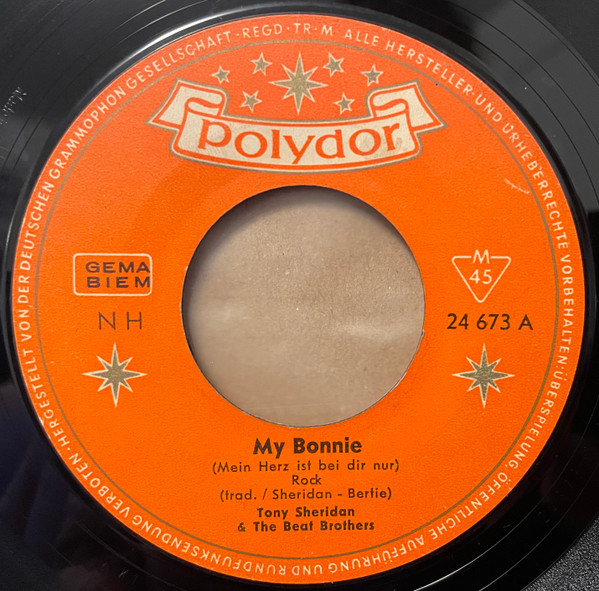
Where can I find the Beatles' first record in Hamburg? It isn't credited to "the Beatles" — it's "My Bonnie" by Tony Sheridan and the Beat Brothers (Polydor, 1961), recorded in Hamburg with the future Beatles as an uncredited backing band. Look for it in general secondhand bins, filed under "S" for Sheridan, not under "Beatles."
Is there a Beatles museum in Hamburg? No. Beatlemania Hamburg closed for good in 2012 for lack of visitors. Only physical sites remain: Beatles-Platz, the Kaiserkeller (still an active club), and the Star-Club plaque.
Which shops are open on Sundays in Hamburg? Almost none — Sunday is the weak day for record shopping across the whole city. It is, however, Fischmarkt day (5–9:30am), an institution not to be missed regardless.
What's worth hunting in Hamburg beyond the Beatles? Hamburg named Krautrock (Faust, 1973) and produced the Hamburger Schule, Germany's defining 1990s indie scene (Blumfeld, Tocotronic, Die Sterne). It's also one of Germany's house and techno capitals, based out of St. Pauli.
A record to hunt in Hamburg
Every episode in this series closes with one record to hunt in that city. In Hamburg it could only be the record almost nobody searches for under its real name.
Which pressing? Check it on Discogs ↗
Recorded on 22 June 1961 at the Friedrich-Ebert-Halle, produced by Bert Kaempfert, with the future Beatles as a backing band credited as "the Beat Brothers" to avoid an unfortunate collision with a piece of German slang. Growing demand for imported copies of this single among Liverpool fans is what eventually sent Brian Epstein to a record shop counter asking about a local band he'd never heard of.
The tell: the first pressing (October 1961) carries the word "Rock" on both labels and a spoken German introduction on the A-side, with no picture sleeve — that arrives only with the 1962 reissue. The January 1962 reissue, labelled "Twist" with an English intro, is the version that circulates far more often. Prices run from around €26 to over €300, with a median near €70 for a decent first pressing; the companion LP, My Bonnie (Polydor 46 612, 1962), is rarer still.
In Hamburg, hunt it in the general secondhand bins — Freiheit & Roosen, Plattenrille — filed under "Sheridan," never under "Beatles." It's the only place on earth where finding it actually means anything: the city where it was recorded, by the producer who recorded it, in the port that made it possible.
The Vinyl Cities series continues. Subscribe to the Groov-illa newsletter to catch the next episodes.
Live in Hamburg and have corrections, tips, or a shop that deserves a mention? Write to hello@groovilla.com. We update this guide periodically.