Madrid and its record shops
Episode 15 of the Vinyl Cities series
Sunday, a quarter past nine, Plaza de Cascorro. The stalls of the Rastro run downhill along Ribera de Curtidores as far as you can see: chairs, coats, old cameras, crockery, and here and there a cardboard box of old records. There's no record section, no map, no order. You walk, you stop at every box, and by half past two the traders are already folding up their tables.
The Rastro is the best introduction to how Madrid works, because it shows you the city's clock. Madrid doesn't run on the hours of London or Vienna. Its record shops open around eleven, close at two, stay shut through the long lunch, open again at five, and keep the lights on until half past eight or nine at night. On Sunday nearly everything is closed, except the market and the handful of shops clustered round it.
Arrive with another city's rhythm and you'll lose half your day standing at a lowered shutter. Adjust, and Madrid hands you hours other capitals don't have. The evening, when the shops are still open and the streets are full, is the best time to dig: unhurried and sociable. The rule of this guide is simple. Dig in the morning and the evening, eat lunch late like a madrileño, and keep Sunday morning for the Rastro.
A Short History: From the Censor's Desk to the Movida
For almost forty years under Franco, every lyric sung in Spain had to pass a censor's office before it could become a record. Between 1960 and 1977 more than four thousand songs were barred from radio and television, and a number of foreign album covers were altered for the Spanish market. Buying anything beyond the approved catalogue was hard, and importing it was close to an act of defiance: in 1977 José Escribano opened Escridiscos and started bringing in British new releases before anyone else in town.
Franco died in November 1975. A few years later Madrid erupted into what became known as the movida madrileña: punk, new wave, synth pop and rock all at once, in the same clubs, on the same small labels. The gig usually named as its starting point took place on 9 February 1980, a tribute to a drummer called Canito, killed in a road accident, held in the main hall of the city's civil engineering school; Nacha Pop, Alaska y los Pegamoides and the future Los Secretos shared the bill. In 1982 came DRO, Spain's first independent label, which became the scene's official channel.
That catalogue, alongside the flamenco and Spanish pop of the 60s and 70s, is still what fills the racks in the centre. And the shops, almost all of them, keep the hours of the city that made it.
Hours checked in October 2026 from public sources: they can change.
The Centre: Callao, Ópera and Gran Vía
Between Callao and Ópera, within a few hundred metres, is the densest cluster in the city: seven shops, all a quarter of an hour apart on foot.
Discos La Metralleta (Plaza de San Martín 1, in the Descalzas car-park arcade, metro Ópera, Mon-Tue & Thu-Sat 10-1:45 & 5-8:30, closed Wednesday and Sunday) bills itself as Madrid's oldest collectors' record shop and sits somewhere you'd never look: a shopping arcade underneath a car park. Every genre, plus tapes and DVDs. Wednesday is closed.
Discos Babel (Costanilla de los Ángeles 5, metro Ópera, Mon-Fri 11-2:30 & 5:30-7:30, Sat 10:30-2:30) is one of the old names of Madrid collecting: psych, garage, prog, 60s and 70s beat, hard rock, punk, power pop, jazz and bossa, with first pressings, books and magazines.
Bangla Desh (Costanilla de los Ángeles 5, metro Ópera, Mon-Sat 11-2 & 5-8:30) shares the address, has been trading since 1982 and moved through two earlier premises before landing here. These days it focuses on collectables and special editions, with a soft spot for heavy metal.
Escridiscos (Calle de las Navas de Tolosa 4, metro Callao, Mon-Sat 11-2:30 & 5-8:30) is José Escribano's shop, opened in 1977: the British-import pioneer, which also ran a label of its own, Twins. It has since passed to new owners and specialises in power pop.
La Gramola (Calle del Postigo de San Martín 4, metro Callao, hours vary: check Google Maps or their socials before you go) buys and sells vinyl, rarities and live records, with vintage posters, badges and T-shirts alongside.
Killer's Discos (Calle de la Montera 28, metro Gran Vía, Mon-Sat 10:30-2 & 5-8:30) started out as a Rastro stall more than forty years ago and specialises in 60s rock. The shop has announced a closing-down sale ahead of the owner's retirement: go while you can.
Rotor Discos (Gran Vía 40, second floor, door 2, metro Callao, Mon-Fri 11-2 & 5-8:45, Sat 11-2) is up on the second floor of a building on the Gran Vía and has been the city's avant-garde shop since 1986: industrial, krautrock, minimal synth, ambient, experimental electronics and a deep run of Spanish underground. Saturday closes at lunch.
Malasaña: Jazz, Club Music and Late Nights
The Movida's old neighbourhood is now where the shops stay open until nine.
Jazz y Más (Calle de la Palma 28, metro Tribunal, Mon-Sat 11-2:30 & 5:30-9) began as a mail-order business and is the place for jazz and black music, with a book section too. There's a second branch nearby at Calle Dos de Mayo 10.
Recycled Music Center & Friperie (Corredera Baja de San Pablo 34, metro Tribunal, Mon-Fri 11-8:30, Sat 12-8:30, Sun 12-6:30) breaks the city's rules: no lunch break, and open on Sunday. Used electronic music, more than twenty thousand records from private collections, and a rail of second-hand clothes.
ATER COSMO Vinyl Store (Calle de la Puebla 9, metro Gran Vía, Mon-Sat 11:30-3 & 4:30-9) is the club-music shop: Detroit techno, dub and acid, house and electro, run by Unkle Fon and Fabio Moretti.
Lavapiés and La Latina: Books, Ska and Sunday
South of the centre, in the two neighbourhoods around the Rastro, are three shops and the market itself.
Bajoelvolcán (Calle del Ave María 42, metro Lavapiés, Mon-Fri 11-2 & 5-9, Sat 11:30-2:30 & 5-9) is a bookshop and record shop in one, opened in 2010, with jazz as its specialty. The name comes from Malcolm Lowry's novel Under the Volcano.
Liquidator Music (Calle de las Dos Hermanas 22, metro La Latina, Mon-Sat 11-2 & 5-8:30, Sun 11-3) is shop and label: ska, rocksteady, reggae and soul, lots of 7-inches and a catalogue of its own. It opens on Sunday mornings, which makes it the natural partner to the Rastro.
Discos Ziggy (Calle de los Estudios 6, metro La Latina, Mon-Sat 10-8:30, Sun 10-7:30) is a hundred metres from the station and a step from the market: records from every era, CDs, tapes and comics, with no lunch break, every day of the week.
Nakasha (Calle de Andrés Mellado 24, metro Argüelles, Mon & Wed-Fri 11-2 & 5-8:30, Sat 11-2:30 & 5-8:30, closed Tuesday and Sunday) is the one shop outside these areas, up in Argüelles to the north-west: overstock and second-hand vinyl, CDs and DVDs. Closed on Tuesday.
| Shop | Area | Specialty |
|---|---|---|
| Discos La Metralleta | Centro | Collectables, all genres |
| Discos Babel | Centro | Psych, garage, prog, punk |
| Bangla Desh | Centro | Collectables, heavy metal |
| Escridiscos | Centro | Power pop |
| La Gramola | Centro | Rarities, live records |
| Killer's Discos | Centro | 60s rock |
| Rotor Discos | Centro | Avant-garde, industrial, experimental |
| Jazz y Más | Malasaña | Jazz, black music |
| Recycled Music Center | Malasaña | Used electronic |
| ATER COSMO | Malasaña | Techno, house, electro |
| Bajoelvolcán | Lavapiés | Jazz, books |
| Liquidator Music | La Latina | Ska, rocksteady, reggae, soul |
| Discos Ziggy | La Latina | Every era, comics |
| Nakasha | Argüelles | Overstock and used |
Sunday at the Rastro
The Rastro runs every Sunday and public holiday from 9am to 3pm, from Plaza de Cascorro down Ribera de Curtidores to Ronda de Toledo; the nearest metro is La Latina. There's no dedicated record area: crates turn up here and there among the clothes, furniture and bric-a-brac, and you find them stall by stall. Traders start packing up around half past two, so go early.
After the market, three shops are open within walking distance: Liquidator until 3pm, Discos Ziggy all day, and Recycled over in Malasaña from midday.
What to Look For in Madrid
DRO and 3 Cipreses. First pressings on the Movida's two key independent labels are the most distinctively Madrid thing you can collect. Parálisis Permanente's El Acto (3 Cipreses 3C-003, 1982) is the emblem of the scene's darker side; DRO's roster included Siniestro Total, Glutamato Ye-Yé and Gabinete Caligari.
Hispavox. The big Madrid label that carried the Movida onto the radio: besides Radio Futura's debut, there's Alaska y los Pegamoides' Bailando, the biggest pop hit of those years.
Camarón and Paco de Lucía. The two met in Madrid, at the Tablao Torres Bermejas, where Camarón sang for twelve years, from 1968 to 1980. Their partnership produced the Philips albums from 1969 onwards; the first, con la colaboración especial de Paco de Lucía, is one of the grails in the book's chapter.
Censored sleeves. Under Franco some foreign covers were altered for the Spanish market. The famous case is the Rolling Stones' Sticky Fingers, whose zip cover was replaced with a different image in Spain. Those editions are collected today precisely because they're different.
Reading a Spanish pressing. The Depósito Legal on the label or the back of the sleeve gives you the city and the year: an "M" with a year close to the release date is the first sign of an original Madrid pressing. Then check the matrices in the run-out groove.
Recommended Itineraries
A morning in the centre. Escridiscos, La Gramola, La Metralleta, Babel and Bangla Desh between Callao and Ópera, then Rotor on the Gran Vía. Start at eleven and finish by two, before the shutters come down.
An evening in Malasaña. From five onwards: Jazz y Más, Recycled and ATER COSMO, all open until half past eight or nine. Then dinner, late, the way it's done here.
Sunday. The Rastro from nine, then Liquidator and Discos Ziggy in La Latina. If you still have the energy, Recycled in Malasaña in the afternoon.
Lavapiés, slowly. Bajoelvolcán in the afternoon, once it reopens, with a book to browse alongside the records.
Practicalities
The lunch break is the rule. Almost every shop closes from around two until five. The exceptions are Recycled Music Center and Discos Ziggy, which stay open straight through.
Sunday. Nearly everything is shut, except the Rastro, Liquidator Music (mornings), Discos Ziggy and Recycled Music Center.
Days to check. La Metralleta closes on Wednesday, Nakasha on Tuesday, Rotor on Saturday afternoon.
Metro. Almost every shop is a few minutes from a station: Ópera, Callao and Gran Vía for the centre; Tribunal and Gran Vía for Malasaña; Lavapiés and La Latina for the south; Argüelles for Nakasha. Stations checked against the open data of the Consorcio Regional de Transportes de Madrid (CRTM).
Reading a Spanish sleeve. Spanish pressings carry a Depósito Legal, a registration number with a provincial code and a year: "M" for Madrid, "B" for Barcelona. It's the quickest way to tell where and when a copy was pressed.
Frequently Asked Questions
Where can I buy vinyl in Madrid? The main cluster is between Callao and Ópera: Escridiscos, La Gramola, Discos La Metralleta, Discos Babel, Bangla Desh and Rotor Discos are a few minutes apart on foot. Malasaña has Jazz y Más, Recycled Music Center and ATER COSMO; La Latina has Liquidator Music and Discos Ziggy.
Do Madrid record shops close for lunch? Almost all of them, roughly from 2pm to 5pm, then they stay open until 8:30 or 9pm. Recycled Music Center and Discos Ziggy are open all day without a break.
Where can I buy records on a Sunday in Madrid? At the Rastro, every Sunday from 9am to 3pm from Plaza de Cascorro down Ribera de Curtidores, and in the shops nearby: Liquidator Music in the morning, Discos Ziggy all day, and Recycled Music Center in Malasaña from midday.
Where can I buy electronic music on vinyl in Madrid? ATER COSMO in Malasaña for techno, house and electro; Recycled Music Center for used electronic records; Rotor Discos on the Gran Vía for industrial, ambient and experimental music.
Where can I find Movida records in Madrid? In the shops of the centre: Escridiscos, which was importing British releases as early as 1977, Discos La Metralleta and Discos Babel. To spot a Madrid pressing, check the Depósito Legal: the letter M means Madrid.
Where can I find ska and reggae in Madrid? At Liquidator Music in La Latina, a shop and label specialising in ska, rocksteady, reggae and soul, with plenty of 7-inches. It's open on Sunday mornings too.
A Record to Hunt for in Madrid
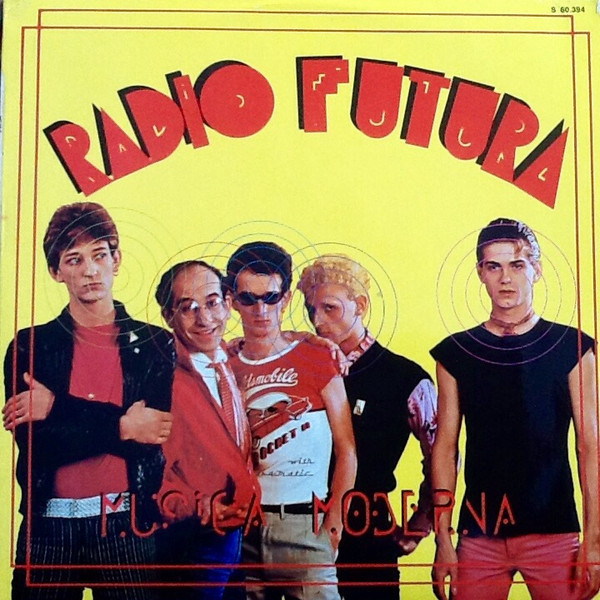
Música Moderna is Radio Futura's debut, released in 1980, the year the Movida took off. It's the sound of a city that had just been allowed to be modern, ironic and free, and it's the right record for this guide because it carries the date and place of its birth printed on it.
The Hispavox first pressing is catalogue S 60.394. The decisive detail is the Depósito Legal: M.10.186-1980 on the label and M.13.330-1980 on the insert. That "M" tells you the record was pressed in Madrid. The insert is black and white, and the matrices in the run-out groove carry Hispavox's wave-shaped mark.
In town, ask at Escridiscos, Discos Babel and La Metralleta, the shops with the deepest Spanish collectables. The Madrid entry in The Grail Hunt has the identification details and links to search for a copy.
The Madrid chapter of The Grail Hunt: Europe goes further: fifteen shops and three records, from Camarón's flamenco to the Movida, with the details you need to recognise a first pressing at the rack.
The Vinyl Cities series continues. Subscribe to the Groov-illa newsletter so you don't miss the next episode.
If you live in Madrid and have corrections, tips or a shop that deserves a mention, write to hello@groovilla.com. We update the guide regularly.